Dog dental care at home is one of the most effective things you can do to protect your dog’s long-term health and one of the most commonly skipped parts of a pet care routine.
It doesn’t require expensive equipment or a lot of time. What it requires is consistency and a clear understanding of what you’re actually trying to prevent. In dogs, dental disease does not begin with suffering. It begins with plaque, a soft bacterial film covering the teeth hours after a meal.
Left undisturbed, that plaque hardens into tartar within 24 to 48 hours. Tartar irritates the gums, triggers inflammation, and sets the stage for the kind of damage that takes months or years to become visible. By the time a dog shows obvious discomfort, the problem has often been developing for a long time.
The challenge is that most dogs don’t show pain the way humans do. They keep eating, keep playing, and give no obvious sign that their gums are bleeding or that a tooth is loose.
This is why home care matters so much: it’s not about responding to a difficulty. It’s about preventing one from taking hold in the first place.
The goal is to provide you enough information to build a routine that actually holds up, rather than one that sounds thorough on paper but doesn’t account for what dogs actually tolerate.
Why does dog dental health start at home?
Dog dental health starts at home because plaque forms every single day, and daily intervention is the only way to stay ahead of it. Professional cleaning removes what has already mineralized, but the window between one appointment and the next is filled by what you do or don’t do in your own kitchen.
Plaque is a thin, sticky layer of bacteria that adheres to tooth surfaces after every meal. In dogs, it begins forming within four to six hours of eating.
Left alone for 24 to 48 hours, it absorbs calcium from saliva and hardens into tartar. No brush or chew removes tartar once it mineralizes. That process belongs to professional cleaning.
How plaque turns into tartar
Plaque starts as a soft, colorless film. In the early stages, a toothbrush disrupts it easily. The problem begins when that window closes and the film mineralizes into tartar, which is also called calculus.
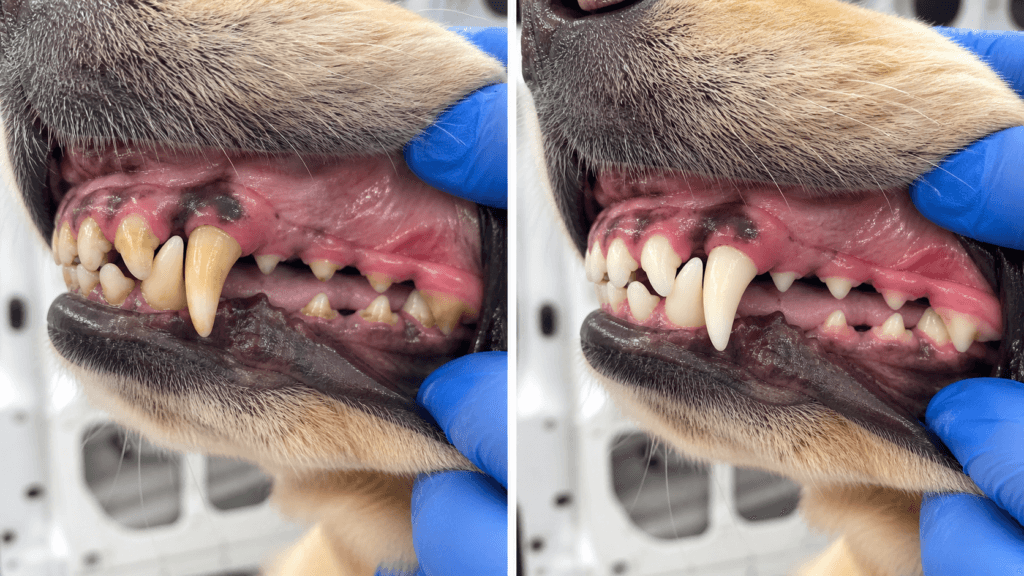
Tartar is yellowish to brown, rough in texture, and adheres firmly to the tooth surface. Once formed, it creates an ideal surface for additional bacterial accumulation, which accelerates the progression toward gum disease.
In small-breed dogs, this cycle can move faster because teeth are more crowded and saliva flow is different. A Chihuahua or Yorkshire Terrier, for example, may develop visible tartar in a shorter period than a larger breed under the same home care conditions.
What happens to the gums and bone over time
Tartar that sits along the gumline triggers an inflammatory response. The gums become red, swollen, and prone to bleeding when touched. This stage is gingivitis, and at this point the damage is still reversible with professional cleaning and improved home care.
If the inflammation continues without intervention, it progresses to periodontal disease. Bacteria work their way beneath the gumline, destroying the ligaments and bone that hold the teeth in place. This process is largely silent.
The dog eats, plays, and behaves normally while the structural damage accumulates underneath. According to the AVDC, most dogs develop some degree of periodontal disease before age three.
Bone loss, once it occurs, does not reverse. Prevention is the only strategy that keeps the structure intact.
Why early care makes a long-term difference
A dog that receives consistent home care from puppyhood enters adulthood with slower tartar accumulation and healthier gum tissue. That baseline makes professional cleanings less intensive, less frequent in some cases, and more effective when they do happen.
A dog that reaches age five or six without any home routine typically arrives at its first professional cleaning with significant tartar buildup, receding gums, and sometimes early bone loss already present.
The cleaning removes the tartar, but the gum tissue and bone don’t return to their previous state on their own. The treatment becomes reactive rather than preventive, and the gap between what could have been and what is becomes harder to close.
What can you actually do at home for your dog’s teeth?
The most effective thing you can do at home for your dog’s teeth is brush them daily with a dog-safe toothpaste. Everything else, including dental chews, water additives, and dental wipes, plays a supporting role.
None of these replace brushing, but all of them are better than doing nothing on days when brushing isn’t possible. Here are the main tools available for at-home dog dental care, in order of effectiveness:
- Brushing with an enzymatic toothpaste
- Dental chews with a VOHC seal of acceptance
- Water additives approved by the Veterinary Oral Health Council (VOHC)
- Dental wipes or finger brushes
- Dental-specific diets designed to mechanically reduce plaque
Brushing
When it comes to how to brush dog teeth, the technique matters less than the frequency. A dog brushed gently and briefly every day gets more benefit than one brushed perfectly once a week. The goal is to disrupt the plaque film before it mineralizes, and that happens on a daily cycle.
Start by letting your dog sniff and lick the toothpaste without the brush. Most dogs accept enzymatic toothpastes, which come in flavors like chicken or peanut butter. After a few sessions, introduce the brush at the front teeth only. Gradually work toward the back molars over the course of a week or two. Most dogs accept the full routine within two to three weeks when the introduction is slow and consistent.
The American Veterinary Medical Association (AVMA) recommends daily brushing as the gold standard for dog dental care at home. If daily brushing isn’t possible, every other day is a meaningful second option. Less frequent than that, and the plaque cycle begins to win.
Only use toothpaste made for dogs. Human toothpaste contains fluoride and xylitol, both of which are toxic to dogs.
Dental chews, water additives, and wipes
Dental chews work through mechanical abrasion as the dog chews and through enzymatic action in products with added ingredients that target bacterial biofilm. They don’t reach every surface of every tooth, and they don’t remove established tartar.
But used daily as part of dog teeth cleaning at home, they meaningfully slow plaque accumulation between brushing sessions. The table below compares the main at-home dental care methods:
| Method | Removes plaque | Removes tartar | Reaches below gumline | Requires cooperation |
| Brushing | Yes | No | Partially | Yes |
| Dental chews (VOHC) | Partially | No | No | Moderate |
| Water additives | Partially | No | No | Minimal |
| Dental wipes | Partially | No | No | Moderate |
| Finger brush | Yes | No | Partially | Yes |
Water additives are mixed into the dog’s drinking water and work through antibacterial or enzymatic action on bacteria in the mouth. They’re a low-effort addition to a home routine, not a standalone strategy.
Dental wipes cover accessible surfaces and are useful for dogs that won’t tolerate a brush at all. They’re less effective than brushing but better than no contact with the tooth surface.
What are the signs that home care is no longer enough?
When home care is no longer enough, the dog’s mouth usually gives visible signals before any other symptom appears. Identifying these signs early is itself a form of prevention: the sooner you act, the less damage accumulates and the more straightforward the professional intervention becomes.
The most common warning signs of dental disease in dogs include:
- Persistent bad breath that doesn’t improve after brushing
- Visible yellow or brown buildup along the gumline
- Red, swollen, or bleeding gums
- Pawing at the mouth or rubbing the face against surfaces
- Difficulty chewing, dropping food, or chewing on one side only
- Visible loose teeth or teeth that have shifted position
- Reduced interest in food or chew toys the dog previously enjoyed
Bad breath in dogs is often dismissed as normal, but persistent halitosis is one of the earliest signs of bacterial buildup progressing beyond what brushing controls.
A dog’s breath after a meal is different from the chronic, sharp odor of active gum disease. If the smell is consistent and doesn’t respond to brushing, it typically points to something happening below the surface.
📣 Ready to go beyond home care? Schedule a professional anesthesia-free cleaning with mobile dog teeth cleaning near me.
How does professional cleaning complement what you do at home?
Professional home care and cleaning help with various mouth problems for your dog. Home cleaning eliminates soft plaque from easily reachable tooth surfaces and removes hardened tartar from all surfaces. Including the areas below the gumline where brushing cannot reach.
The most important distinction is the gumline. Tartar accumulates at and below the junction between the tooth and the gum, in a space called the sulcus.
This is where periodontal disease originates. No toothbrush, chew, or water additive reaches that space effectively. Only professional instruments operated by a trained technician can safely clean that area.
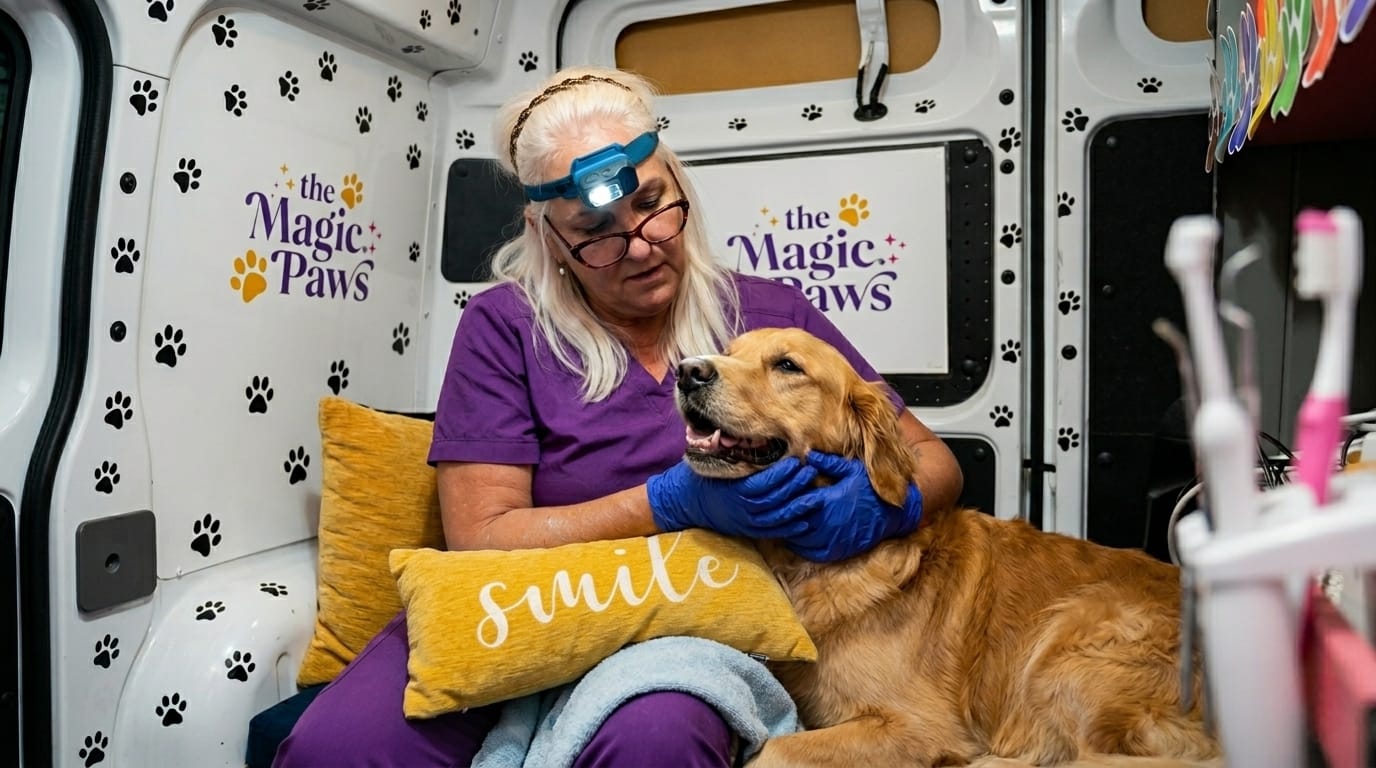
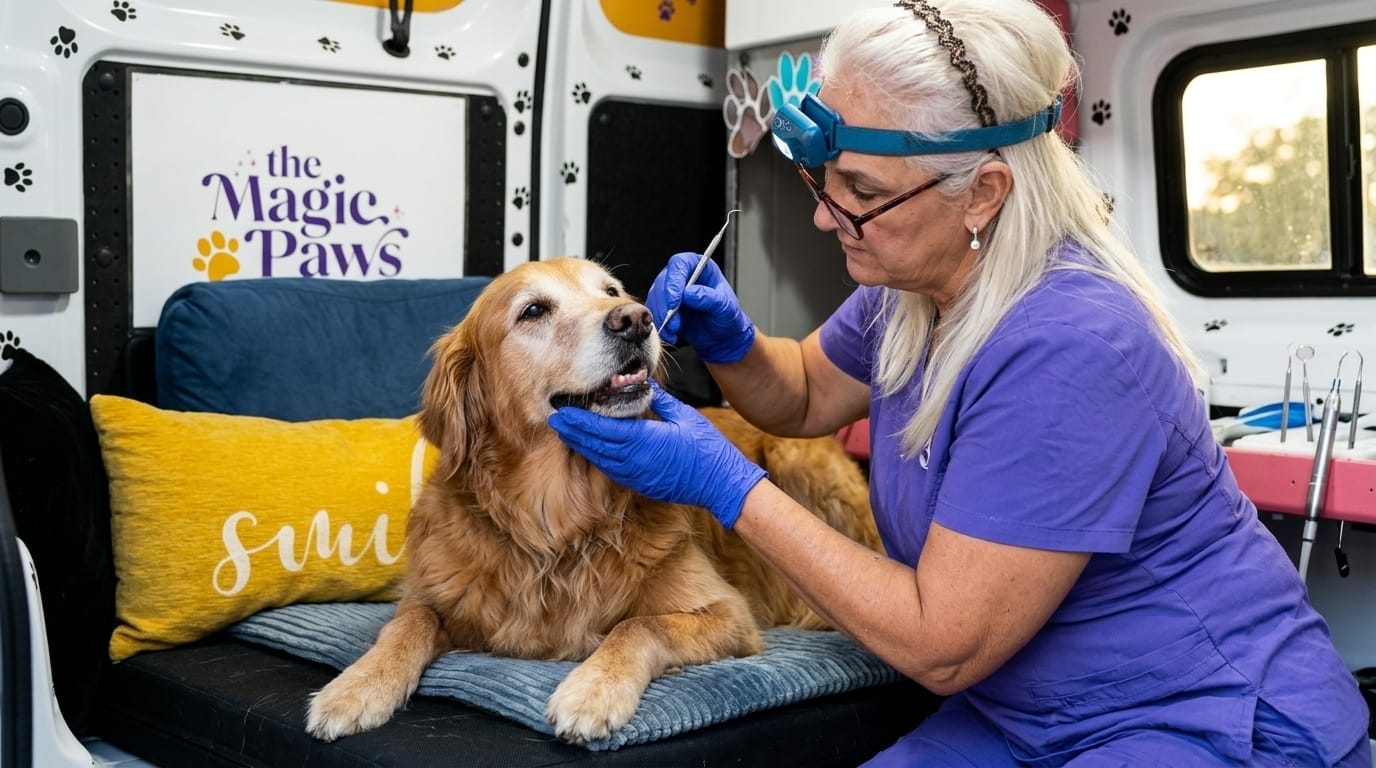
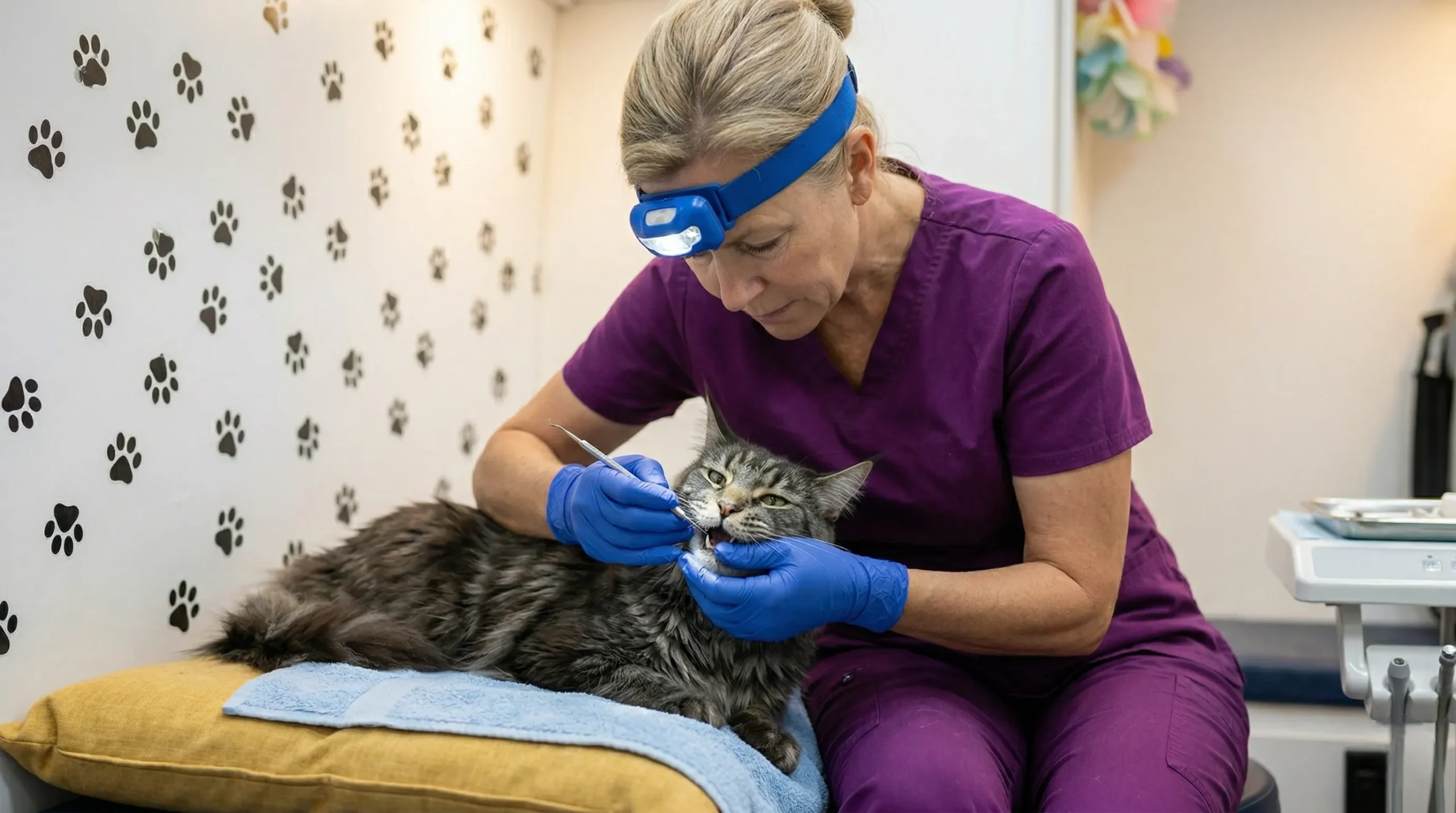
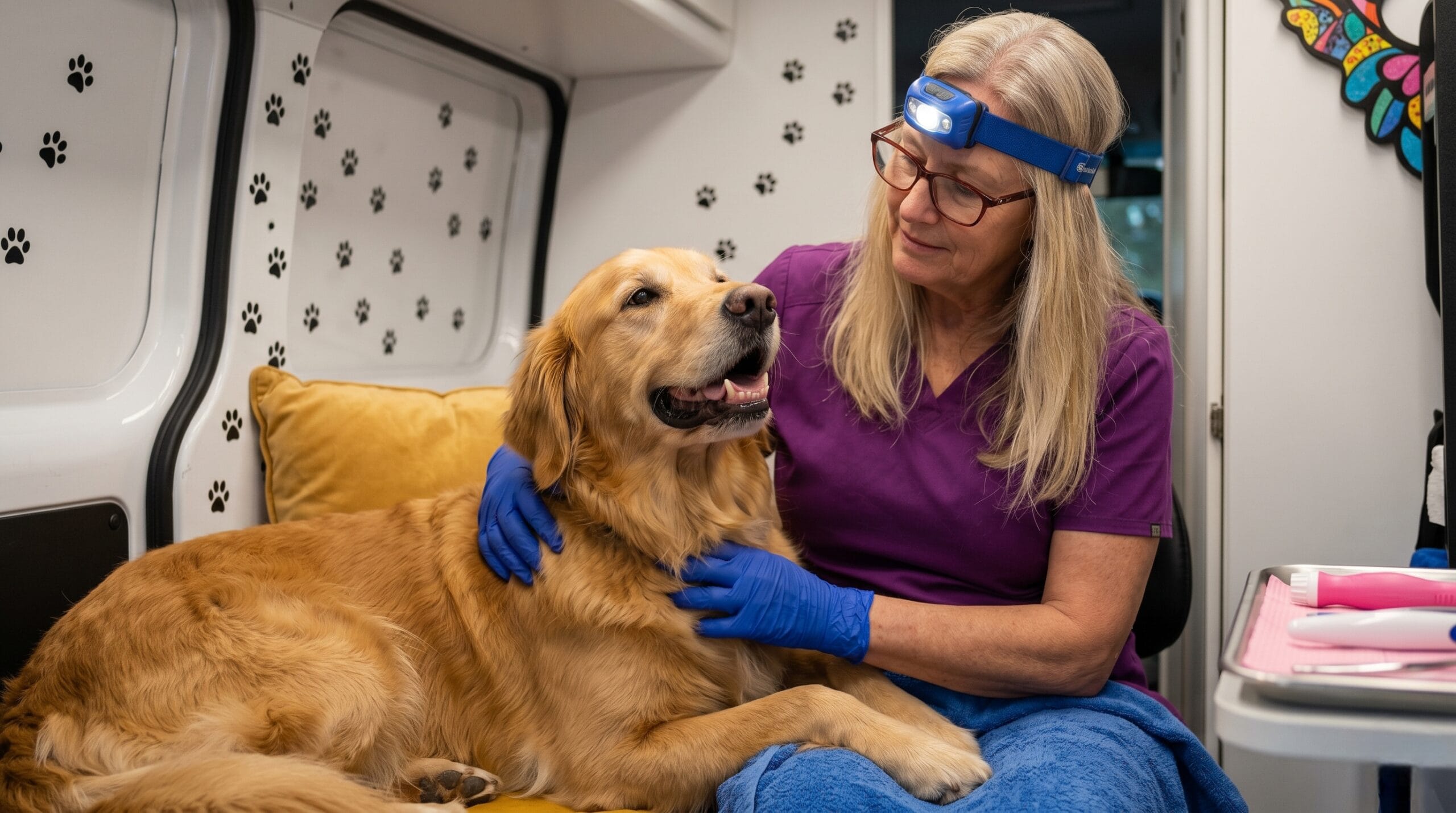
This is where The Magic Paws changes the dynamic for dog owners in South Florida and Orlando. The service is performed inside a dedicated mobile van that comes to you by a trained female technician in purple scrubs and blue nitrile gloves.
The procedure uses Senses Therapy, a proprietary four-component protocol designed to keep the animal calm without anesthesia or sedation.
For owners who’ve avoided professional cleaning because they’re concerned about how their dog handles stress in clinical settings, this combination matters. A calm dog is a cooperative dog, and a cooperative dog gets a more thorough cleaning.
You can read more about the difference between what home care covers and what a professional session addresses in this guide to professional pet dental cleaning.
What happens during an anesthesia-free cleaning?
An anesthesia-free dog teeth cleaning performed by The Magic Paws follows a structured process that begins before the technician touches the dog’s teeth.
The procedure takes place entirely inside the branded white Nissan NV200 van, which is outfitted specifically for this service. The controlled environment is part of the protocol.
Senses Therapy is what makes that environment effective. It combines four components applied together throughout the session:
- Aromatherapy: calming scents are introduced into the van’s environment to reduce the animal’s stress response before and during the procedure
- Music therapy: specific audio frequencies are played to keep the dog in a lower-alert state
- Chromotherapy: lighting calibrated to calm wavelengths creates an environment less stimulating than a typical clinical setting
- Massage: gentle manual contact reduces muscle tension and reinforces the animal’s sense of safety throughout the cleaning
With the dog calm and cooperative, the technician cleans the accessible tooth surfaces and the area at and around the gumline, removing tartar that home care cannot address. The session covers the visible dental surfaces that accumulate the most buildup.
Anesthesia-free cleaning is appropriate for dogs without advanced periodontal disease. If the technician identifies signs that go beyond what the procedure covers, such as tooth mobility or significant infection below the gumline, the recommendation will be to consult a veterinarian for a full evaluation.
The Magic Paws positions its service as preventive care, not a replacement for veterinary dentistry when veterinary dentistry is what the dog needs.
You can learn more about what separates this approach from a conventional clinic visit by reading about anesthesia-free dog teeth cleaning.
How often should your dog get a professional cleaning?
Most dogs benefit from professional dental cleaning every six to 12 months. The right frequency depends on the dog’s size, breed, existing oral condition, and how consistent the home care routine is.
Our recommendation is an annual professional dental assessment for most dogs, with more frequent cleanings for animals that accumulate tartar faster or have a history of periodontal disease.
Because of dental crowding and greater rates of early tartar development, small-breed dogs regularly require more frequent professional cleaning than larger breeds in practice. General guidelines by profile:
| Profile | Recommended frequency |
| Large breed, consistent home care, no history of disease | Every 12 months |
| Small or toy breed, good home care | Every 6 to 9 months |
| Any breed with a history of periodontal disease | Every 4 to 6 months |
| Dog with no home care routine | Every 6 months minimum |
| Senior dog (7 years and older) | Every 6 months, with vet evaluation |
These are starting points, not fixed rules. For example, a beagle that gets brushed daily and eats a dental-specific diet may do well with annual cleaning. A Maltese that refuses all at-home dental care and has already had one episode of gingivitis may need cleaning every four months. The best guide is what the technician or veterinarian observes at each appointment.
After all, dog dental cleaning costs vary depending on the animal’s size, location, and oral condition. Anesthesia-free mobile services like The Magic Paws tend to sit below the price range of full veterinary cleanings with general anesthesia, which can reach $300 to $1,000 depending on the clinic and the dog’s condition.
If you’re in Central Florida, you can also explore options on our dog dentist in Orlando page.
Is your dog’s mouth telling you something you have been missing?
Most dog owners who reach this point in an article already know the answer. The brushing has been inconsistent, and the breath has been an issue for a while. The dog has been avoiding the chew toys it used to love. These are not coincidences, and they’re not things that get better on their own.
Dog dental care at home works when it’s consistent. It reduces the pace of plaque accumulation, extends the time between professional cleanings, and keeps the gum tissue in better condition going into each appointment. But it works as a system, not as a substitute for the part of dental health that only a professional can address.
The dogs that reach age eight, ten, or twelve with most of their teeth intact and no history of major dental intervention are almost always the ones whose owners built both habits: a daily home routine and a scheduled professional cleaning before problems compounded. The window where prevention is easy is longer than most people think, but it doesn’t stay open indefinitely.
Your dog’s teeth won’t wait. Book a professional anesthesia-free cleaning with The Magic Paws and keep the disease from getting ahead of you!
FAQ
Can I clean my dog’s teeth without a toothbrush?
Yes, alternatives exist. Dental wipes, water additives, and VOHC-approved dental chews can all slow plaque accumulation on tooth surfaces. None of them, however, reach the gumline as effectively as a brush, and none remove established tartar. They’re useful supplements on days when brushing isn’t possible, not long-term replacements for it.
At what age should I start brushing my dog’s teeth?
As early as possible. Puppies that are introduced to a toothbrush between eight and 16 weeks of age are significantly more tolerant of the routine as adults. The ideal window is before the first visible tartar appears, which can happen as early as age one in small breeds. Adult dogs can also learn to accept brushing with a gradual introduction, but the earlier you start, the easier the habit is to maintain.
How long does it take for plaque to turn into tartar on a dog’s teeth?
Plaque begins mineralizing into tartar in under 24 hours. This is the core reason why daily brushing is recommended rather than weekly. Each day without mechanical disruption is a day the plaque film moves closer to becoming the calcified tartar that only professional instruments remove.
Is bad breath in dogs always a sign of dental disease?
Not always, but in most cases the connection is direct. Occasional breath odor after eating certain foods is normal. Persistent halitosis that doesn’t improve after brushing, or that has a sharp, consistent quality regardless of diet, is almost always linked to bacterial activity in the mouth. It’s one of the earliest and most reliable signs that plaque or tartar is progressing toward something more serious.
Can dental disease in dogs affect their heart and kidneys?
Yes. Bacteria from active periodontal disease can enter the bloodstream through inflamed gum tissue and reach the heart, kidneys, and liver. The AVMA has documented the link between periodontal disease and systemic organ damage in dogs (https://www.avma.org/resources-tools/pet-owners/petcare/pet-dental-care). This is why dental care is classified as preventive health care, not cosmetic maintenance.
How much does a professional dog teeth cleaning cost without anesthesia?
The cost varies depending on the dog’s size, location, and the amount of tartar present. Anesthesia-free services like dog teeth cleaning near me with The Magic Paws tend to be more accessible than full veterinary cleanings with general anesthesia, which can range from $300 to $1,000. Contact The Magic Paws directly for a quote based on your dog’s specific profile.
How often should I take my dog to get their teeth professionally cleaned?
Most dogs benefit from professional cleaning every six to 12 months. Small breeds and dogs with a history of periodontal disease often need more frequent appointments, sometimes every four to six months. The AVMA recommends at least one professional dental assessment per year as a baseline. The ideal frequency for your dog depends on breed, size, and the consistency of your home care routine.
What dog breeds are most prone to dental disease?
Small and toy breeds carry the highest risk because their teeth are crowded into a smaller jaw, leaving less space between teeth and more surface area for tartar to accumulate. Chihuahuas, Poodles, Yorkshire Terriers, Maltese, and Dachshunds are among the most commonly affected. Greyhounds are also predisposed due to the texture of their tooth enamel. These breeds benefit from stricter home care routines and more frequent professional cleanings.
Is anesthesia-free dog teeth cleaning safe and effective?
Yes, for eligible dogs. It is effective for removing visible plaque and tartar from accessible tooth surfaces and the area around the gumline. The Magic Paws uses Senses Therapy, a proprietary protocol that combines aromatherapy, music therapy, chromotherapy, and massage to keep the animal calm and cooperative throughout the session. Dogs with advanced periodontal disease, severe tooth mobility, or infection below the gumline may require a full veterinary evaluation before or instead of an anesthesia-free session.
What is the difference between dog teeth cleaning at home and professional cleaning?
| Home care | Professional cleaning | |
| Removes plaque | Yes | Yes |
| Removes tartar | No | Yes |
| Reaches below gumline | No | Yes |
| Assesses gum health | No | Yes |
| Frequency | Daily | Every 6 to 12 months |
Home care prevents plaque from becoming tartar. Professional cleaning removes the tartar that formed anyway, and addresses what happens below the gumline where brushing cannot reach. Both are necessary. Neither replaces the other.