Finding a reliable dog dentist in Orlando takes more than a quick search. The region offers a mix of traditional veterinary clinics, mobile services, and anesthesia-free providers, each with a different scope, protocol, and price point. For a pet owner who wants to make an informed decision, knowing what separates a qualified provider from a generic one changes the entire evaluation process.
Oral health is one of the areas most consistently neglected in routine pet care. Most owners brush or use dental treats at home, but these measures reach only the surface of the teeth. Plaque and tartar accumulate below the gumline long before bad breath or discomfort become visible, and by the time a dog shows behavioral changes related to dental pain, the condition is usually already advanced.
Orlando’s climate and the pace of daily life in Central Florida also shape how owners approach pet care. A service that arrives at the front door, causes no disruption to the family’s schedule, and avoids the stress of a clinic environment fits how many residents in the region prefer to handle routine maintenance for their animals.
This guide covers what to look for when evaluating a dog dentist in Orlando: the clinical criteria that matter, the difference between anesthesia-based and anesthesia-free care, how to assess a provider’s protocol, and what The Magic Paws’ mobile model looks like in practice.
Why does your dog’s dental health matter more than most owners realize?
Periodontal disease is the most common health condition diagnosed in adult dogs. It progresses quietly: plaque accumulates, hardens into tartar, pushes below the gumline, and triggers chronic inflammation that the animal rarely communicates clearly. By the time an owner notices persistent bad breath or a change in eating behavior, the condition has typically been developing for months.
According to the American Veterinary Medical Association, most dogs show signs of periodontal disease by age three. At that stage, the infection is no longer isolated to the mouth.
The connection between oral bacteria and your dog’s vital organs
Bacteria from infected gum tissue enter the bloodstream and travel to organs. The heart, kidneys, and liver are the systems most frequently affected by chronic oral infection in dogs. Research cited by the Cornell University College of Veterinary Medicine confirms that untreated dental disease carries systemic consequences that go well beyond discomfort.
For a medium-sized mixed breed, the progression might be invisible for years. The animal eats, plays, and sleeps normally while plaque accumulates daily and tartar hardens into deposits that no home care routine can remove. Professional cleaning breaks that cycle before organ involvement becomes a real risk.
Prevention is not a supplementary concern for dog owners in Orlando. It is the primary reason to establish a dental care routine early, before the disease reaches a stage that requires clinical intervention.
How often should dogs get a professional dental cleaning?
Most dogs benefit from professional dental cleaning once or twice a year. The right frequency depends on three variables: age, breed, and the current state of the animal’s mouth.
Smaller breeds and brachycephalic dogs, such as French Bulldogs and Pugs, tend to accumulate tartar faster due to tooth crowding and shorter jaw structure. For these pets, semi-annual cleanings are often the minimum. Larger breeds with wider spacing between teeth may manage well with a single annual session, provided home care is consistent.
Age also matters. Younger animals who begin professional oral care early typically maintain better gum health and require less frequent intervention as they grow older.
Dogs who start regular professional cleaning after age five may need more frequent sessions initially to bring the mouth back to a manageable baseline.
For owners who want a complete overview of what professional oral care involves at each stage of a dog’s life, everything you need to know about dog dental cleaning covers the procedure, the tools used, and what to expect from start to finish.
What should you look for when choosing a dog dentist in Orlando?
A good dog dentist in Orlando demonstrates four things clearly: documented training, a defined behavioral protocol, honest communication about the scope of the service, and transparent pricing. Any provider who is vague on any of these points deserves a follow-up question before booking.
Use the following criteria as a checklist when evaluating options in the Orlando area:
Training documentation
Confirm that the provider can identify the certification or supervisory structure behind their practice. In Florida, procedures performed on animals require a licensed veterinarian or a professional operating under direct veterinary supervision.
If a service cannot explain this clearly, that is a warning sign.
Behavioral protocol
Ask specifically how the provider keeps a dog calm without sedation. A professional answer names a defined system with specific components.
“We’re gentle with animals” is not a protocol. A detailed description of the calming method, including how the provider responds if a dog becomes distressed, reflects real preparation.
Eligibility assessment
A responsible provider evaluates the animal’s condition before cleaning, not after arriving at the door. If a dog is not a suitable candidate on a given day due to inflammation, visible disease, or temperament, the session should stop without charge.
This policy is the clearest indicator of professional ethics in anesthesia-free care.
Pricing structure
Pricing should be tied to clear criteria, typically based on the animal’s size. Vague estimates or fees that appear only at the end of a session are red flags. Knowing dog dental cleaning cost beforehand helps owners set expectations and compare providers without surprises.
Scope of service
Anesthesia-free dental cleaning removes visible plaque and tartar above and at the gumline. Any provider who claims to replace clinical procedures for advanced periodontal disease is overstating what the service delivers.
Honest communication about this distinction separates a trustworthy provider from one that is not.
What qualifies someone to clean your dog’s teeth?
Veterinary dentistry and anesthesia-free dental hygiene are two different scopes of practice. A veterinary dentist operates inside a clinical setting with full diagnostic capacity: X-rays, subgingival scaling, extractions, and treatment of active disease. An anesthesia-free dental hygiene provider focuses on preventive maintenance for pets without active periodontal infection.
Neither scope is superior in isolation. They address different stages of the same problem. What matters is that the provider is honest about which category their service falls into and does not claim to perform procedures that require clinical tools and sedation.
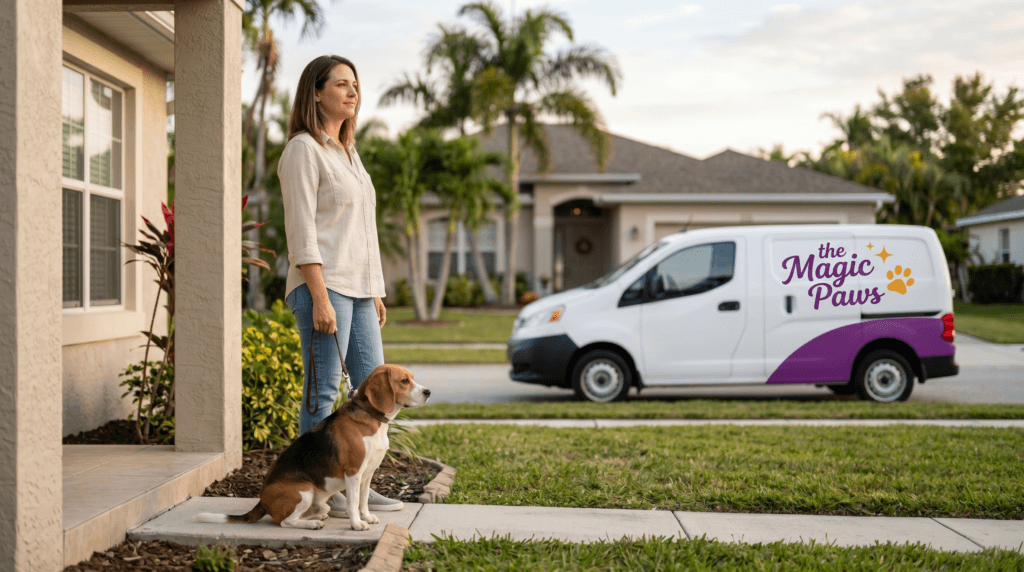
The Magic Paws is led by Illana Reisner, a licensed dentist who brings clinical knowledge to the anesthesia-free mobile model. That credential shapes how the team assesses each animal’s eligibility and how they communicate limits to owners before a session begins. To understand whether dog dental cleanings are safe in a specific situation, the evaluation always starts with the individual’s current oral condition.
Mobile vs. clinic: which model works better for dogs in Orlando?
The choice between a mobile service and a traditional veterinary clinic depends on the dog’s health status, temperament, and the type of procedure needed. For preventive maintenance in a healthy animal, the two models differ significantly in convenience, cost, and the animal’s stress response.
| Factor | Mobile anesthesia-free | Veterinary clinic |
| Setting | Owner’s home or driveway | Clinic environment |
| Anesthesia required | No | Yes (for full COHAT) |
| Procedure scope | Preventive maintenance | Diagnostic + treatment |
| Session duration | 45 to 60 minutes | 4 to 8 hours (including recovery) |
| Stress for the animal | Low: familiar environment | Higher: unfamiliar setting, sedation |
| Cost | Lower, no anesthesia fees | Higher, includes pre-anesthetic labs |
| Suitable for | Healthy dogs, preventive care | Dogs with active disease, advanced buildup |
For animals who are already showing signs of advanced periodontal disease, gingivitis, or tooth loss, a veterinary clinic with full diagnostic capability is the appropriate choice. The mobile model is not a replacement for that level of care.
For healthy animals in Orlando and the broader Central Florida region, the mobile option reduces stress for the pet and eliminates the logistical burden for the owner. Information on mobile pet dental cleaning in Central Florida covers the service areas and what owners can expect from the at-home format.
What questions should you ask before booking an appointment?
Before scheduling with any provider offering non anesthetic dog teeth cleaning, five questions help confirm the service is appropriate:
- What is your training background, and are you operating under veterinary supervision?
- How do you assess whether a pet is a suitable candidate before the session begins?
- What happens if my puppy becomes too distressed to continue?
- What does the cleaning include, and what conditions would you refer to a vet instead of treating?
- Is pricing fixed, and are there any fees that could be added after the session?
A provider who answers these questions directly and without deflection demonstrates the kind of transparency that warrants trust. Vague or defensive responses to any of the five are a signal to keep looking.
Is anesthesia-free dog dental cleaning safe?
Anesthesia-free dog dental cleaning is safe for preventive maintenance in eligible pets. It does not carry the sedation risks associated with clinic-based procedures and works well for healthy animals without active periodontal infection. It is not a replacement for clinical treatment in dogs with advanced disease, significant subgingival buildup, or teeth that require extraction.
The key word in that answer is “eligible.” Not every dog qualifies for a sedation-free session on a given day. Age, temperament, current oral condition, and the presence of underlying health issues all affect whether the procedure is appropriate. A responsible provider conducts an assessment before starting, not after.
For older animals in Central Florida, anesthesia-free cleaning is particularly relevant. Sedation risks increase with age and pre-existing conditions, making the mobile non-anesthetic option a practical choice for senior dogs who need regular maintenance but whose owners want to avoid the risks of general anesthesia.
Knowing how long a dog dental cleaning takes also helps owners prepare: a mobile session runs between 45 minutes and one hour, with no recovery period afterward.
What the major veterinary organizations say about anesthesia-free cleaning?
The American Veterinary Dental College and the VCA Animal Hospitals have both published positions on anesthesia-free dental procedures. Their concern centers on the limits of what can be performed on an awake dog: subgingival scaling, the removal of calculus below the gumline, dental radiographs, and treatment of active infection all require sedation to be done safely and effectively.
These positions are worth reading carefully, because they address a specific claim: that anesthesia-free cleaning replaces clinical dental work. That claim is not what responsible providers in this category make.
The AVMA and AVDC positions do not argue against preventive maintenance for healthy dogs. They argue against misrepresentation of what the procedure delivers. A provider that positions anesthesia-free cleaning as a diagnostic or therapeutic service is the problem the organizations are describing, not one that is transparent about scope.
The Magic Paws’ approach treats the service as preventive care, not clinical intervention, and communicates that distinction clearly to every owner before booking.
Which dogs are good candidates for anesthesia-free dental cleaning?
The best candidates are dogs with mild to moderate tartar buildup, no signs of active gum infection, no loose or fractured teeth, and a temperament that allows gentle handling without significant distress. Age alone is not a disqualifying factor: many senior dogs tolerate the procedure well, particularly when they have had positive experiences with it since young adulthood.
Dogs with advanced periodontal disease, visible gum recession, significant subgingival calculus, or behavioral responses that prevent safe handling are better served by a veterinary clinic with sedation capability.
The goal of eligibility assessment is not to exclude animals unnecessarily but to make sure the dog receives the right type of care for its actual condition.
Magic Paws evaluates every dog before each session. If the assessment indicates that the animal’s oral condition or behavior makes the procedure inadvisable that day, the session stops. The owner is not charged for an incomplete cleaning, and a referral to a veterinarian is recommended when the situation warrants it.
How does The Magic Paws approach dog dental care in Orlando?
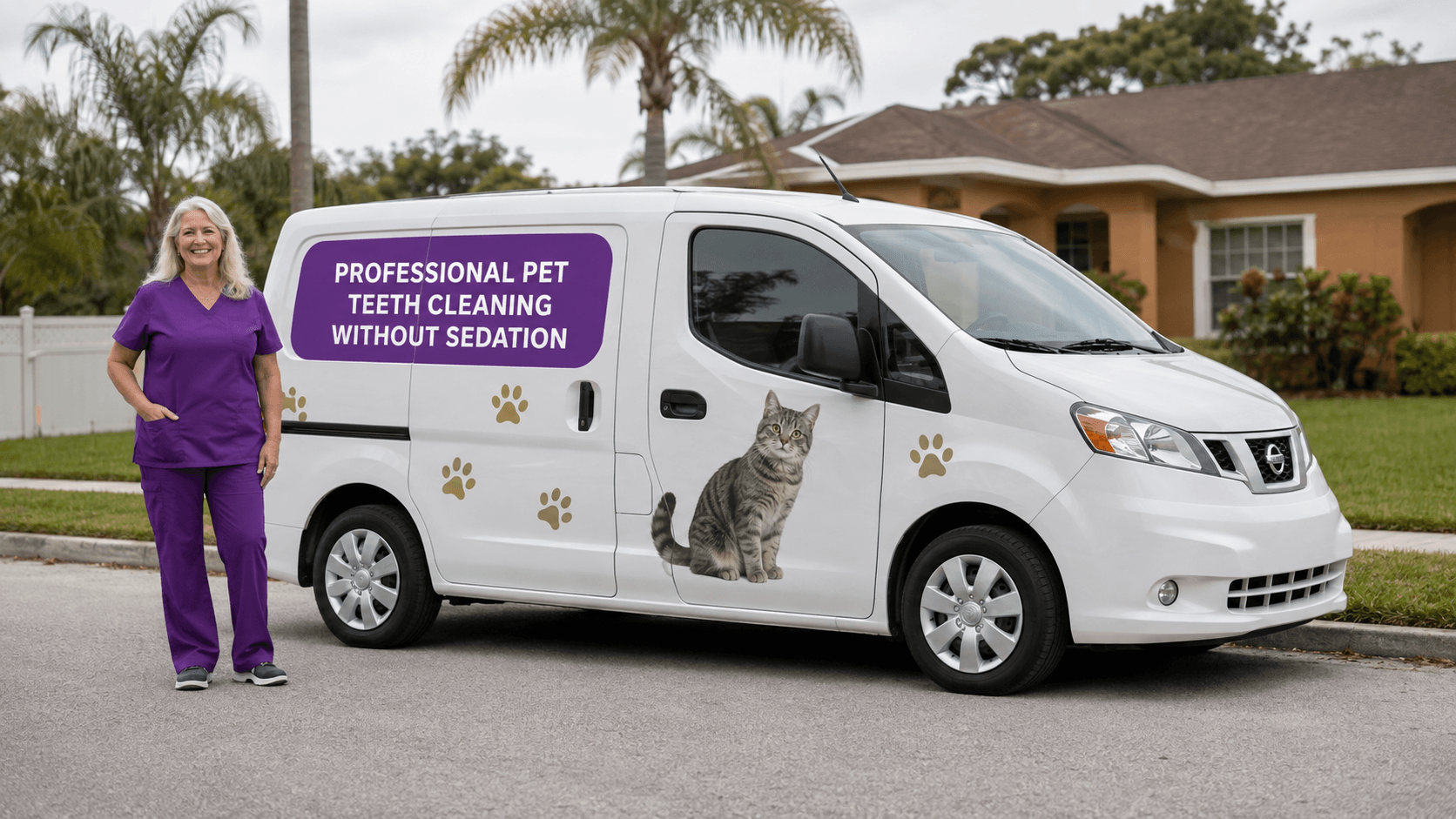
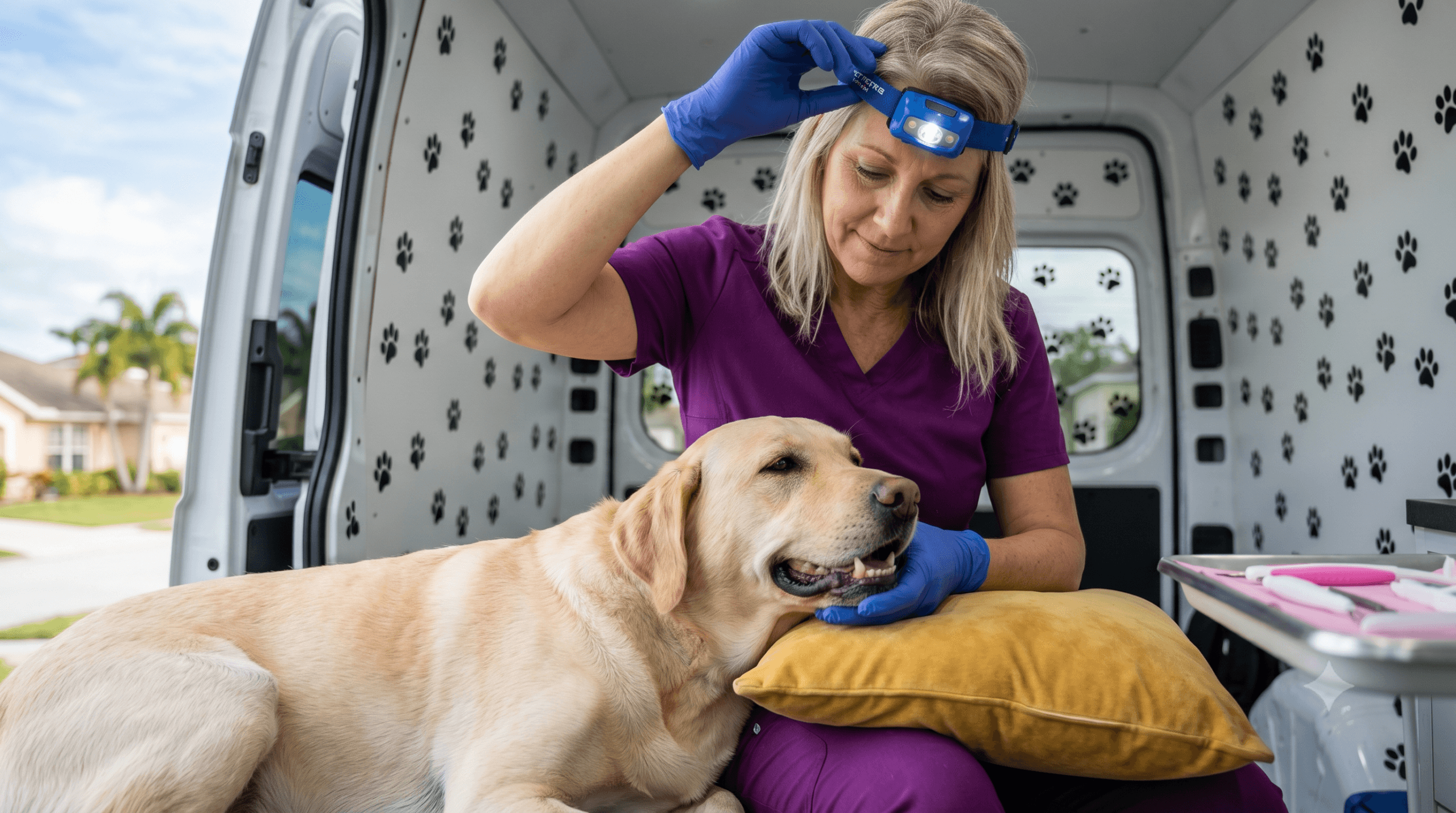
The Magic Paws provides anesthesia-free mobile dental cleaning for dogs across Orlando and Central Florida, performing each session inside a fully equipped van at the owner’s home. The team uses the Senses Therapy protocol to keep animals calm throughout the procedure: aromatherapy, music therapy, chromotherapy, and massage work together to reduce stress before and during the cleaning.
The service was built around a simple observation: most dogs who resist dental procedures at a clinic behave very differently in a familiar environment.
Removing the clinic setting, the unfamiliar smells, and the disruption of car travel changes the animal’s baseline state before the procedure even begins.
What is the Senses Therapy protocol and how does it keep dogs calm?
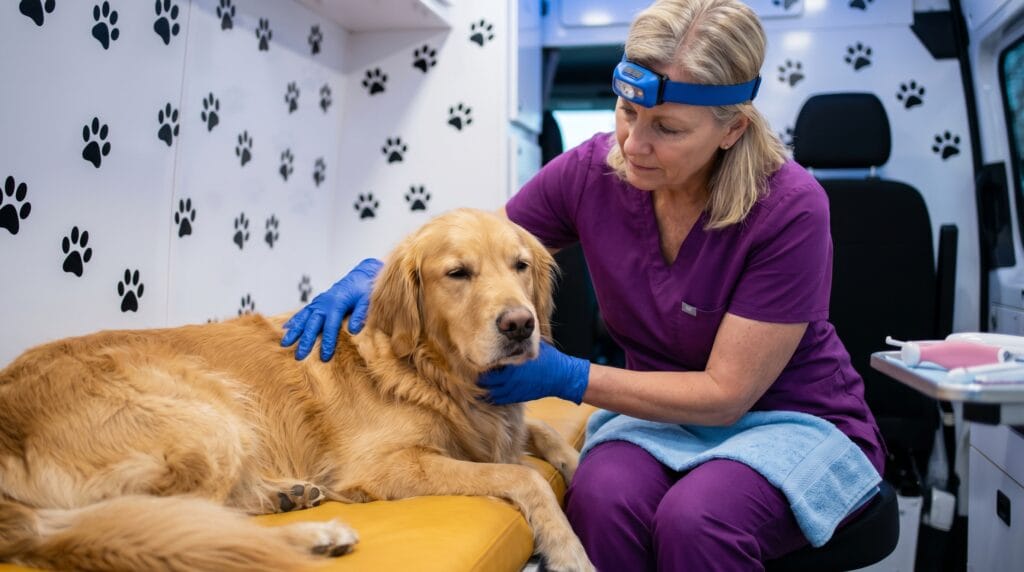
Senses Therapy is The Magic Paws’ proprietary calming protocol, applied before and during each dental session. It combines four components:
Aromatherapy uses carefully selected scents to reduce anxiety and create a calm sensory environment inside the van. Music therapy uses specific audio frequencies and rhythms shown to lower stress responses in dogs. Chromotherapy introduces color wavelengths through lighting that supports a relaxed physiological state. Massage is applied to muscle groups that carry tension during stressful situations, helping the animal settle before the cleaning begins.
The four components work together rather than in isolation. A dog that is already calm before the first dental instrument contacts its teeth is a dog that will tolerate the procedure without resistance, which improves both the quality of the cleaning and the safety of the session.
See how the Senses Therapy protocol works
What does a session with The Magic Paws look like from start to finish?
The van arrives at the owner’s address in Orlando or the surrounding area at the scheduled time. Before the cleaning begins, the technician conducts a brief oral assessment to confirm the dog is a suitable candidate for the session that day. If the assessment raises any concern, the owner is informed before proceeding.
Once the animal is cleared, the Senses Therapy protocol begins. The calming sequence runs for several minutes while the dog settles into the van environment. The cleaning itself involves removing visible plaque and tartar from the tooth surfaces using professional hygiene tools, with the dog awake and calm throughout.
The full session takes between 45 minutes and one hour, depending on the animal’s size and the amount of buildup present. There is no drop-off, no recovery period, and no waiting. The owner remains available nearby throughout the process. For owners managing post-procedure care, guidance on what to feed your dog after a dental cleaning covers what to offer and what to avoid in the hours following the session.
Owners interested in scheduling regular sessions can also consider the Dental Clean Club, The Magic Paws’ recurring maintenance plan, which makes it easier to keep a consistent cleaning schedule without rebooking from scratch each time.
What is the right choice for your dog’s dental health in Orlando?
The right dog dentist in Orlando is the one whose scope of service matches your animal’s actual needs. For a dog with advanced periodontal disease, loose teeth, or an active oral infection, a veterinary clinic with sedation capability is the appropriate choice. For a healthy dog who needs regular preventive maintenance in a low-stress environment, anesthesia-free mobile care is a practical and well-suited option.
Most owners in Central Florida are in the second category: their animals need routine attention, not clinical intervention. A service that comes to the door, runs in under an hour, and uses a defined calming protocol addresses that need without the cost, recovery time, or sedation risks of a full COHAT procedure.
The criteria covered in this guide: training documentation, behavioral protocol, eligibility assessment, pricing transparency, and honest communication about scope, apply to any provider you evaluate. A dog dentist worth trusting answers all five areas clearly before you hand over your animal.
Your dog’s next dental cleaning doesn’t have to mean a full day at the clinic. Book a session with The Magic Paws and we come to you in Orlando.
FAQ to Dog Dentist in Orlando
What does a dog dentist do differently from a regular vet?
A dog dentist focuses specifically on oral health: evaluating teeth, gums, and plaque buildup, rather than providing general health care. Some providers, like The Magic Paws, specialize in anesthesia-free preventive cleaning using structured protocols, which differs from full dental procedures performed under sedation at veterinary clinics.
How much does dog dental cleaning cost in Orlando?
The cost varies depending on the provider and method. Anesthesia-free mobile cleaning tends to be more affordable than clinic-based procedures under sedation, which include pre-anesthetic blood work, monitoring, and recovery time. The Magic Paws offers transparent, size-based pricing with no hidden fees.
Can I take my senior dog to an anesthesia-free dental cleaning?
In many cases, yes. Senior dogs are often better candidates for anesthesia-free cleaning precisely because sedation risks increase with age and pre-existing conditions. Eligibility is assessed before each session to confirm the procedure is appropriate for the dog’s current health status.
How do I know if my dog needs a dental cleaning?
Common signs include persistent bad breath, yellow or brown buildup on the teeth, red or swollen gums, difficulty chewing, and excessive drooling. Regular professional cleanings are recommended even when symptoms are not visible, since plaque accumulates below the gumline before owners notice changes.
What is the difference between anesthesia and anesthesia-free dog dental cleaning?
Anesthesia-based cleaning is performed at a veterinary clinic under full sedation, allowing for subgingival scaling, dental X-rays, and treatment of disease. Anesthesia-free cleaning is a preventive maintenance procedure performed on a calm, awake dog. It removes visible plaque and tartar but does not replace clinical treatment for advanced periodontal disease.
How long does an anesthesia-free dog dental cleaning take?
A session typically takes between 45 minutes and one hour, depending on the dog’s size and the amount of tartar buildup. This is significantly faster than a clinic-based procedure under anesthesia, which requires drop-off, pre-anesthetic evaluation, recovery time, and pick-up, often a full day.
Is mobile dog dental cleaning available in Orlando?
Yes. The Magic Paws provides anesthesia-free mobile dental cleaning throughout Orlando and Central Florida, including Kissimmee, Winter Park, and surrounding areas. The service is performed inside a fully equipped van at the owner’s residence.
What happens if my dog moves during the cleaning?
The Magic Paws uses the Senses Therapy protocol, combining aromatherapy, music therapy, chromotherapy, and massage, to keep dogs calm and relaxed throughout the session. If a dog is not a suitable candidate on a given day, the session is stopped and the owner is not charged for an incomplete cleaning.
How often should I schedule my dog’s dental cleaning?
Most dogs benefit from a professional cleaning every six months. Dogs prone to rapid tartar buildup, smaller breeds, or those with a history of periodontal disease may need more frequent sessions. A trained provider can assess the animal’s oral condition and recommend an appropriate schedule.
Does The Magic Paws serve all areas of Orlando and Central Florida?
The Magic Paws serves Orlando and the broader Central Florida region, including Kissimmee, Winter Park, and nearby communities. Coverage may vary: checking availability directly with the team at themagicpaws.com is recommended before booking.