How mobile cat teeth cleaning works is a question more Florida owners are asking as interest in anesthesia-free feline care grows. The process is different from what most people expect, and that uncertainty is often what holds someone back from scheduling. Understanding how the session actually unfolds, from the moment the van parks to the moment the technician drives away, tends to resolve most of that hesitation.
A mobile cat dental cleaning happens at the owner’s address. There is no carrier ride to a clinic, no waiting room, and no post-procedure grogginess. The feline stays in its neighborhood, which already removes one of the biggest stress triggers for cats: displacement from familiar territory. The session takes place inside a dedicated mobile unit, not in the owner’s home.
The method works without sedation or anesthesia. Restraint is performed entirely through technique: specific holds, controlled positioning, and a sensory protocol designed to keep the animal calm without pharmacological intervention. This is not a workaround or a compromise. It is an approach built around how cats respond to handling when the environment is right.
The goal is preventive care. Mobile anesthesia-free cleaning addresses plaque and tartar before they develop into periodontal disease or gingivitis. It is not a replacement for veterinary treatment when that treatment is necessary. It is the layer of care that comes before disease takes hold, the kind of maintenance that keeps cats out of the operating room in the first place.
Why do cats need professional teeth cleaning?
Cats require a professional teeth cleaning because plaque builds up on tooth surfaces daily, and once it calcifies into tartar, no amount of brushing at home can remove it. Tartar harbors bacteria that attack the gum tissue and, over time, drive periodontal disease, one of the most common conditions affecting adult cats.
The Cornell University College of Veterinary Medicine reports that a significant percentage of cats over three years old show evidence of periodontal disease, much of it detectable before owners notice any behavioral change. Cats are good at hiding discomfort, which means oral disease often progresses further than it should before anyone catches it.
Professional cat teeth cleaning removes what home care cannot. A trained technician uses instruments to scale calcified deposits from the crown and accessible gum margin, then polishes the surface to slow new plaque from reattaching. This process directly disrupts the bacterial cycle that leads to feline gingivitis and deeper periodontal involvement.
How cats hide dental pain
Cats rarely signal dental pain the way dogs or humans do. A feline with a sore mouth typically continues eating, sometimes favoring one side, and maintains grooming habits even when movement is uncomfortable. Owners often mistake this for resilience, when in reality it reflects a deeply ingrained behavioral response to vulnerability.
The absence of obvious distress is one of the main reasons cat dental health receives less attention than it deserves. By the time a cat drops food, drools, or reacts to being touched near the face, the underlying condition is usually well established. Earlier intervention, before clinical signs appear, is precisely what preventive care is designed to address. If you have noticed any changes in your cat’s eating or grooming patterns, reviewing the signs of dental problems in cats is a useful first step.
What makes mobile cat teeth cleaning different from a vet clinic?
Mobile anesthesia-free cat teeth cleaning differs from a traditional clinic appointment in environment, method, and what happens to the cat before, during, and after the procedure. The two approaches serve different purposes in the care continuum and are not direct substitutes for each other.
The table below compares both options across the factors that matter most to cat owners making this decision.
| Factor | Mobile anesthesia-free | Traditional clinic with anesthesia |
| Location | At the owner’s address | Clinic or veterinary hospital |
| Anesthesia | None | General or local anesthesia |
| Duration | 45 to 60 minutes | Several hours (includes recovery) |
| Recovery time | None | Hours to a full day |
| Transportation stress | Eliminated | Carrier, car, waiting room |
| Scope | Preventive, surface cleaning | Includes extractions, X-rays |
| Recommended frequency | Every 6 months | As clinically indicated |
| Stress level for the cat | Low, sensory protocol | Variable, chemical sedation |
The mobile model does not compete with the clinic. It covers the preventive layer that most cats never receive because the logistical barrier is too high. A cat that does not travel well, that stresses severely in carriers, or that has a medical history that complicates anesthesia is precisely the type of animal that benefits most from a van-based approach.
See how The Magic Paws handles cat dental care from start to finish!
How does the mobile unit work?
The mobile unit is a dedicated, equipped van that functions as a self-contained dental care space. It is not a car, not a trailer, and not a converted cargo vehicle. The interior is designed specifically for the type of calm, controlled environment that anesthesia-free feline care requires.
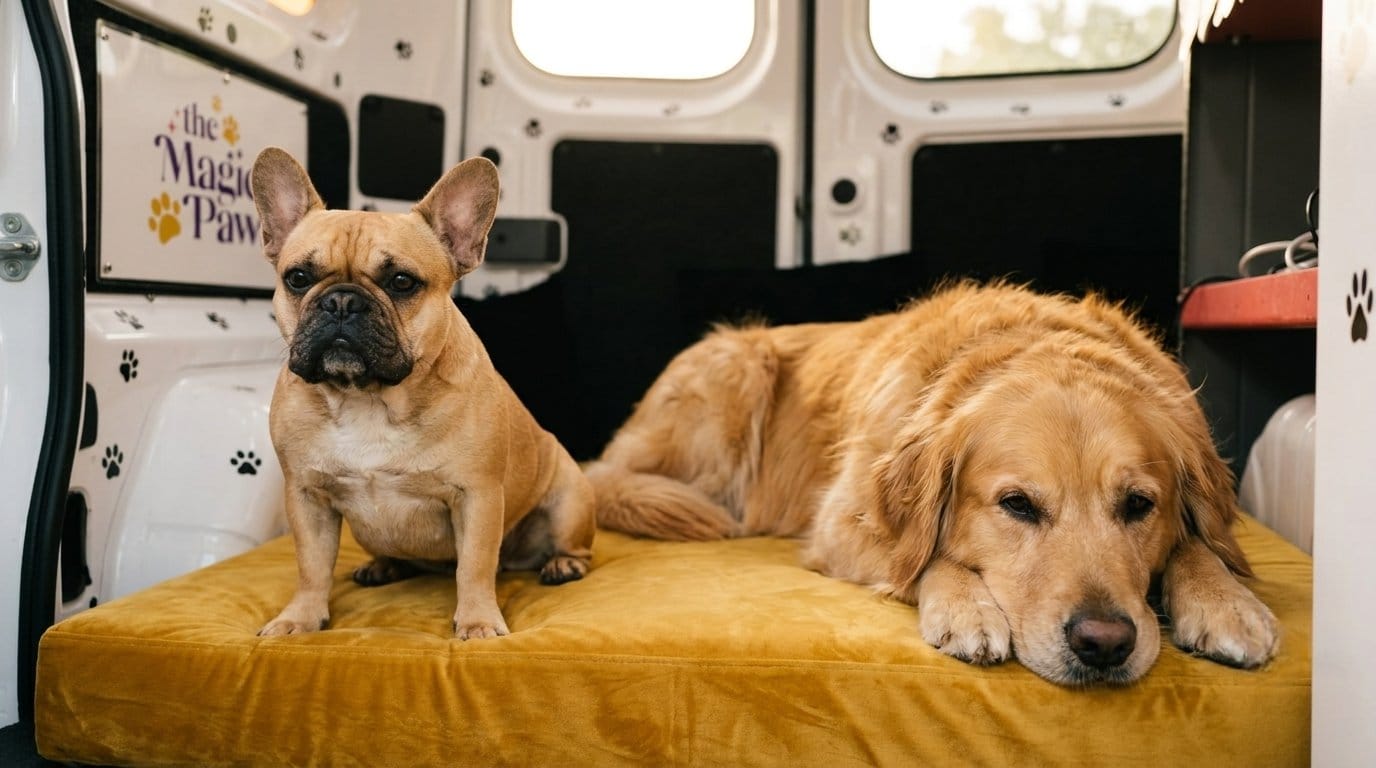
The van that serves Florida clients carries the TMP purple and gold visual identity inside and out: paw-print wall details, a padded surface for the animal, and soft lighting calibrated to avoid the clinical brightness that triggers alertness in cats. The layout keeps instruments organized and out of sight, which matters because visible tools increase feline arousal before a procedure even begins.
For mobile teeth cleaning in cats and dogs, the vehicle setup is part of the method, not just a logistical choice. Removing the cat from a clinic environment while still providing a professional, structured space is what makes the anesthesia-free approach viable. The animal is in a controlled location, with no competing smells, other animals, or strange sounds. That environmental consistency is something a mobile teeth cleaning service delivers in ways a fixed location cannot replicate.
What happens during a mobile cat teeth cleaning, step by step?
A mobile cat dental cleaning follows a structured sequence from the moment the technician arrives. The steps below reflect how a professional cat teeth cleaning process unfolds in practice, not an idealized version of it.
Scheduling and arrival
The session begins before the van arrives. At booking, the owner provides the cat’s health history, age, and any behavioral notes. This intake allows the technician to assess candidacy in advance and prepare for any specific handling considerations. The van parks at the address, and the technician sets up the mobile unit before the animal is brought out.
Initial oral assessment
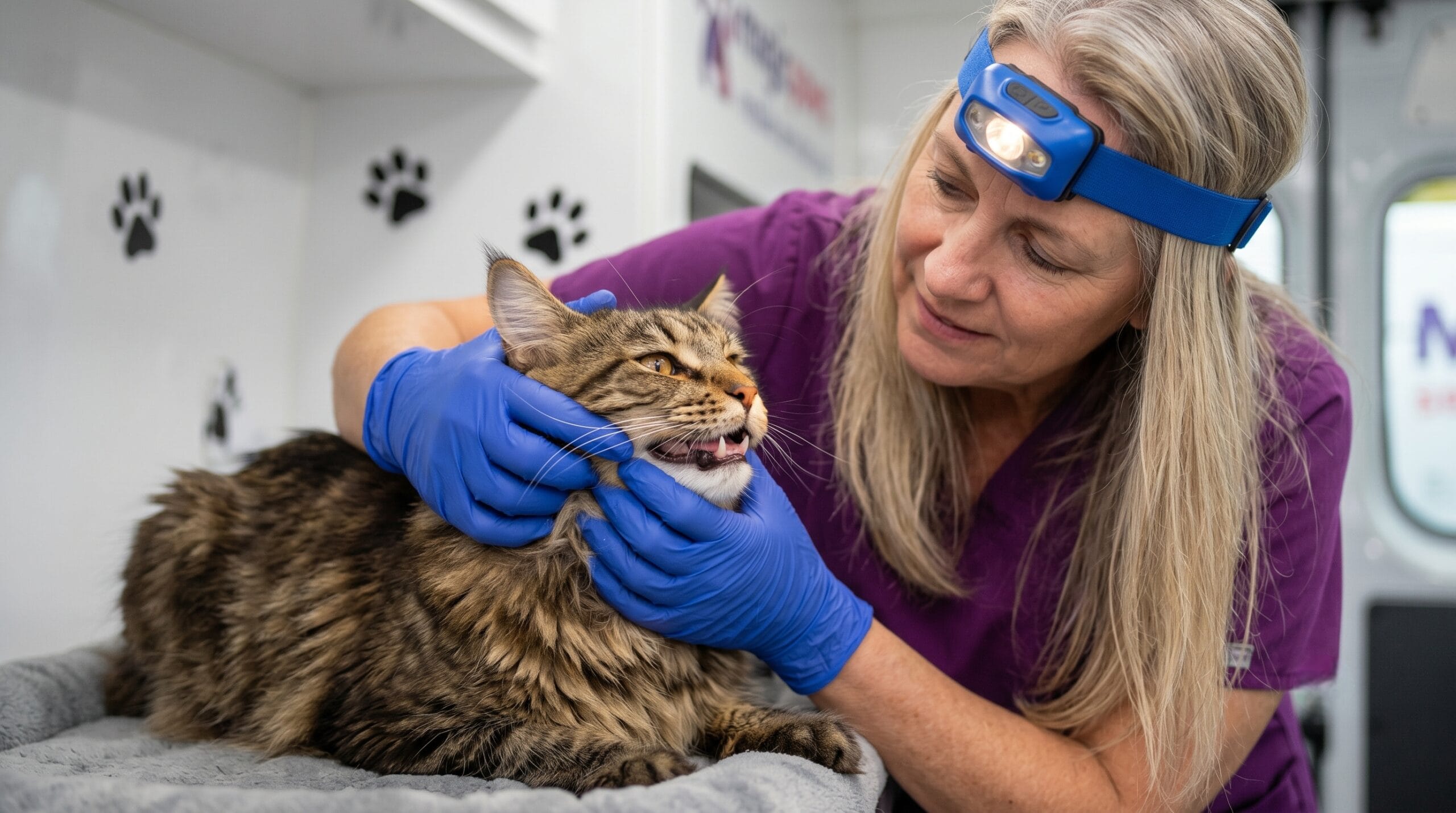
Once the cat is settled on the padded surface inside the van, the technician performs a visual examination of the mouth. This inspection evaluates the gum margin, visible tooth surfaces, and the degree of tartar accumulation. The assessment confirms that the animal is eligible for anesthesia-free cleaning at that session. Cats presenting with advanced periodontal involvement, mobile teeth, or clinical signs that require X-ray evaluation are referred to a veterinarian rather than proceeded with.
Senses Therapy activation
Before scaling begins, the Senses Therapy protocol is activated. This is the sensory calming sequence that defines how The Magic Paws conducts every session. All four components are used in sequence: aromatherapy, music therapy, chromotherapy, and massage. The protocol reduces feline stress at a physiological level and creates the conditions that make restraint by technique, rather than sedation, reliable.
Scaling and plaque removal
With the cat calm and positioned, the technician begins scaling. Instruments are used to remove calcified tartar from the crown and the accessible gum margin. This is the step that addresses what home brushing cannot. According to VCA Animal Hospitals, plaque begins mineralizing into tartar within days of formation, and once hardened, it can only be removed mechanically. The American Veterinary Dental College (AVDC) recognizes scaling as the core clinical intervention in preventive dental care.
Polishing
After scaling, the tooth surface is polished. Polishing removes micro-scratches left by instruments and creates a smoother enamel surface that slows bacterial reattachment. It is not cosmetic. It directly extends the interval before plaque begins accumulating again at a clinically significant rate.
Post-cleaning guidance
The session ends with post-cleaning guidance for the owner. This includes information on cat dental cleaning at home between professional sessions: appropriate brushing technique, suitable products, and behavioral signs to watch for in the weeks following. The technician also recommends the next session interval based on what the assessment revealed, whether that is the standard six months or a shorter cycle for animals with faster tartar accumulation.
What is the Senses Therapy protocol and why does it matter for cats?
Senses Therapy is the proprietary calming protocol used at every Magic Paws appointment. It combines four components in a specific sequence: aromatherapy, music therapy, chromotherapy, and massage. Each component addresses a different aspect of the feline stress response, and together they create the environment in which restraint by technique becomes reliable.
Aromatherapy uses calming essential oils, specifically lavender, which has a documented effect on reducing anxiety in animals. The scent is diffused at a level that is present but not overwhelming, calibrated for feline sensitivity. Music therapy introduces low-frequency, slow-tempo sound, which suppresses the startle response and keeps the cat’s nervous system from escalating during handling. Chromotherapy controls the light color in the space, using warm or violet-spectrum lighting to minimize visual stimulation that would otherwise increase arousal. Massage is applied to specific relaxation points before and during the procedure, activating parasympathetic tone that counteracts the instinctive defensive response most cats have to oral contact.
For cats, the combination matters more than any single element. Felines are sensitive to environmental cues at multiple sensory channels simultaneously. A protocol that addresses only one channel, such as quiet handling alone, leaves the others open to trigger a stress response. Senses Therapy closes those channels together, which is why cats that owners describe as anxious or reactive often behave differently inside the van than they do at a clinic.
Is mobile anesthesia-free cat teeth cleaning safe?
Mobile anesthesia-free cat teeth cleaning is safe for healthy adult cats who pass the initial oral assessment. Safety depends on proper candidacy screening, trained handling, and the technician’s ability to recognize when a case exceeds the scope of anesthesia-free care. Cats with advanced periodontal disease, fractured teeth, or conditions requiring extraction are referred to a licensed veterinarian.
The American Veterinary Medical Association (AVMA) recommends professional dental care as part of a comprehensive feline health routine. The AVMA also recognizes that the scope of care depends on clinical presentation: maintenance cleaning in healthy cats is distinct from therapeutic intervention in diseased mouths. The key distinction in evaluating any anesthesia-free service, as noted by VCA Animal Hospitals, is whether the provider screens for candidacy and refers appropriately when the case warrants it.
The Magic Paws conducts an oral assessment at the start of every appointment. If the assessment reveals conditions that anesthesia-free cleaning cannot safely address, the session does not proceed. This protocol is what separates a well-conducted mobile service from one that prioritizes scheduling over clinical responsibility. Cats that are not suitable candidates are told so directly, with guidance on the next appropriate step.
For owners who want a thorough breakdown of what the process involves and what questions to ask before booking, the anesthesia-free dental cleaning safety guide covers the clinical and practical dimensions in detail.
Check availability in your area and book a session for your cat!
How often should cats get a professional cleaning?
Most adult cats benefit from professional cleaning every six months. Some animals with a history of accelerated tartar, mild gum disease, or predominantly wet-food diets may need more frequent sessions. The initial assessment gives the technician the information needed to recommend the right interval for each cat.
Home maintenance between sessions matters. Brushing with a cat-appropriate toothpaste on a consistent schedule, even a few times a week, meaningfully slows plaque accumulation. Essential dental care routines between visits are part of what keeps the preventive cycle working.
The cleaner the teeth at the start of each appointment, the more the professional session can accomplish. A good reference for building that home routine is the guide on essential pet dental care, which applies to both dogs and cats with minor adjustments.
Frequency also depends on the cat’s stage of life. Younger adults with healthy gums may do well on a once-a-year schedule, at least initially. Mature cats, particularly those over seven, often develop tartar faster and benefit from the six-month interval as a standard.
Age-related changes in saliva composition and immune response affect how quickly oral bacteria establish themselves, which is one reason why the same cleaning schedule does not work equally well across different life stages.
For a more complete reference on what professional care covers and how to approach cat teeth cleaning as part of a year-round routine, the dedicated guide covers both the procedural side and the home care component.
What should you expect after your cat’s first mobile session?
After a mobile cat dental cleaning, the cat can return to its normal routine immediately. There is no recovery period, no restricted activity, and no grogginess. The animal goes back inside, and most owners report that their cat behaves as it would on any other day.
Some animals show mild gum sensitivity in the hours following the session, particularly if tartar accumulation was significant. This is a normal response to scaling and typically resolves within 24 hours. Feeding soft food on the day of the appointment is a reasonable precaution if the technician indicates that sensitivity is likely. Cold water and a quiet space at home are usually enough.
The cat dental cleaning guide offers a thorough walkthrough of what to monitor in the days after the first session and how to build on the professional cleaning with home habits that actually stick. The more consistent the post-appointment routine, the more the next session accomplishes.
First appointments also give both the owner and the technician useful baseline information. The technician sees what the cat’s mouth looks like before any intervention and can compare at the next visit. The owner learns what normal feline oral health looks like and gains a clearer sense of what to watch for between sessions. That shared baseline is part of what makes recurring care more effective over time.
FAQ about how cat teeth cleaning works
How long does a mobile cat teeth cleaning session take?
On average, a session takes between 45 and 60 minutes from start to finish, including the oral assessment and the Senses Therapy protocol. No recovery time is required. The cat is available and back to its normal routine immediately after the technician finishes.
Does my cat need to be sedated for a mobile teeth cleaning?
No. The procedure is performed entirely without anesthesia or sedation. Restraint is achieved through specialized handling technique and the Senses Therapy sensory calming protocol. Cats with advanced dental disease or conditions requiring extraction are referred to a veterinary clinic with anesthetic protocols in place.
Is anesthesia-free cat teeth cleaning as effective as traditional cleaning?
It is effective for prevention and maintenance, removing visible plaque and tartar from the crown and accessible gum margin. For cases involving advanced periodontal disease, mobile teeth, extraction, or deep subgingival involvement, anesthesia is clinically necessary. The two approaches serve different stages of feline oral health, not the same stage through different means.
What should I do to prepare my cat before the session?
Avoid feeding the cat in the two hours before the appointment to reduce the chance of nausea during handling. Keep the environment calm when the van arrives. Avoid play or stimulation that would raise the animal’s arousal level beforehand. Water is fine up to the appointment time.
How do I know if my cat is a good candidate for mobile anesthesia-free cleaning?
Most healthy adult cats are candidates. The oral assessment conducted at the start of every session confirms eligibility on the day. Cats with severe periodontal disease, mobile or fractured teeth, or behavioral patterns that make safe restraint impossible may be referred for anesthetic veterinary care rather than proceeded with.
Can kittens get their teeth cleaned with this method?
Kittens generally do not require professional cleaning in early life stages, as their deciduous teeth are temporary and the adult dentition has not yet fully established. Once dental development reaches a stable point, typically after seven months, anesthesia-free cleaning is appropriate. A consultation before scheduling is recommended for animals under a year old.
How much does mobile cat teeth cleaning cost?
Pricing varies by region, cat profile, and session specifics. Visit the service page at themagicpaws.com to check current rates and availability in your area. No fixed price is stated here because it may not reflect what applies to your location or your cat’s situation.
What if my cat is very anxious or aggressive?
The Senses Therapy protocol was developed specifically to reduce the feline stress response before and during the cleaning. Cats that owners describe as difficult often behave differently inside the van than they do in a clinical environment. In cases of extreme reactivity, the technician evaluates in the moment and decides whether it is safe to proceed. No session continues if the animal’s welfare is at risk.
How often should I schedule my cat’s mobile teeth cleaning?
Most adult cats benefit from a session every six months. Animals with a history of faster tartar accumulation, mild gum inflammation, or wet-food-dominant diets may need more frequent appointments. The technician provides a specific recommendation at the end of each session based on what the oral assessment revealed.
Does The Magic Paws serve my area?
The Magic Paws serves South Florida and the Orlando and Central Florida area. Visit themagicpaws.com to check exact coverage by location and confirm current availability before scheduling.