
How many teeth do dogs have is one of those questions that most owners never think to ask until a puppy starts chewing through furniture. A senior dog starts dropping food from its mouth, or a vet points to the chart on the exam room wall. The answer is not a single number: dogs go through two complete sets of teeth in their lifetime, and each set serves a different biological purpose.
The first set, made up of 28 deciduous teeth, appears in the first weeks of life and does its job for a few months before the permanent teeth start pushing through. The second and final set consists of 42 teeth and is designed to last the animal’s entire adult life. Once those permanent teeth are in place, there is no third round.
Understanding the structure of canine dentition matters beyond satisfying curiosity. Each tooth type in a dog’s mouth has a specific mechanical role, and disruptions to that structure, whether from disease, crowding, or retained baby teeth, have consequences that extend well beyond the mouth. Periodontal disease, which begins at the gumline and progresses silently, is the most common health condition diagnosed in adult dogs.
This guide covers the full picture of dog dental anatomy: how many teeth dogs and puppies have, what the four tooth types do, how the transition between sets works, and what signs indicate a problem worth addressing. Breed-specific differences and cleaning frequency are also covered, because not all mouths follow the same rules.
How many teeth do dogs have?
Adult dogs have 42 permanent teeth divided between the upper jaw (maxilla) and the lower jaw (mandible). Puppies have a smaller set of 28 deciduous teeth, with no molars at this stage. The transition from the first to the second set happens gradually between four and seven months of age, a phase commonly described as teething.
The number 42 often surprises owners who have never had reason to count. It reflects a dentition designed for a species that evolved as a predator and scavenger, where teeth serve several mechanical functions at the same time.
Puppy teeth: the first set
Puppies are born without visible teeth. The deciduous set begins pushing through the gums around three to four weeks of age, with all 28 baby teeth typically in place by six to eight weeks. This first set includes incisors, canines, and premolars, but no molars.
The table below shows how the 28 deciduous teeth are distributed by type and jaw position.
| Tooth type | Upper jaw | Lower jaw | Total |
| Incisors | 6 | 6 | 12 |
| Canines | 2 | 2 | 4 |
| Premolars | 6 | 6 | 12 |
| Total | 14 | 14 | 28 |
Adult teeth: the permanent set
The permanent set adds molars to the lineup and inc
reases the premolar count in the lower jaw. The result is a dentition better equipped for chewing a wider range of food textures and densities.
The table below compares deciduous and adult dentition side by side, which is the format most useful for tracking a dog’s developmental stage.
| Tooth type | Puppy (deciduous) | Adult (permanent) |
| Incisors | 12 | 12 |
| Canines | 4 | 4 |
| Premolars | 12 | 16 |
| Molars | 0 | 10 |
| Total | 28 | 42 |
What are the different types of dog teeth?
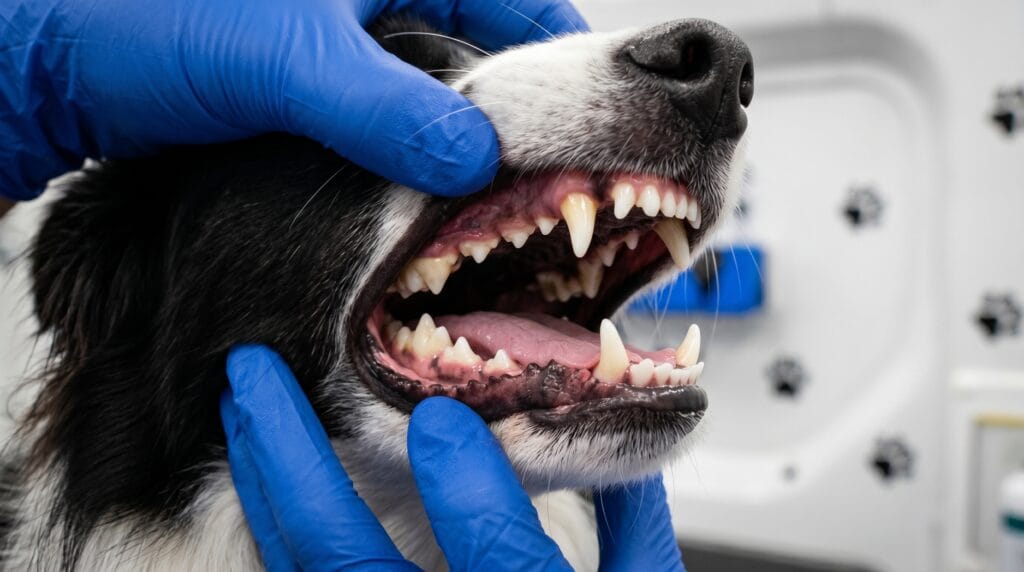
A dog’s mouth contains four distinct tooth types, each occupying a specific position and serving a specific function. Understanding what each type does helps explain why some teeth are more prone to damage or disease than others.
The table below covers all four types, their location, and their primary purpose.
| Tooth type | Position | Function | Count (adult) |
| Incisors | Front of both jaws | Nibbling, grooming, gripping small items | 12 |
| Canines | Corner of each jaw | Holding and tearing | 4 |
| Premolars | Sides of both jaws | Shearing and cutting | 16 |
| Molars | Back of both jaws | Grinding | 10 |
One tooth deserves particular attention in any overview of dog dental anatomy: the carnassial tooth. This is the upper fourth premolar, and it functions as a natural shear blade.
When the mouth closes, the carnassial slides past the lower first molar with a scissor-like action that cuts through tough tissue. Because this tooth bears exceptional mechanical stress, fractures here are more common than in any other part of the mouth, and they tend to go unnoticed until the animal shows visible signs of discomfort.
For owners who want to understand what professional cleaning addresses and why it matters structurally, a detailed look at dog teeth cleaning covers the procedure, what it protects, and how often it should happen.
When do dogs lose their baby teeth?
The teething timeline in dogs is faster and more compressed than in humans. Most puppies complete the transition from deciduous to permanent dentition within a four-month window.
The sequence generally follows this progression:
- 3 to 4 weeks: deciduous incisors begin to erupt
- 4 to 6 weeks: deciduous canines and premolars follow
- 3 to 4 months: permanent incisors begin replacing their predecessors
- 4 to 5 months: permanent canines push through
- 4 to 6 months: permanent premolars erupt
- 5 to 7 months: molars appear (they have no deciduous counterpart)
One complication worth knowing about is retained deciduous teeth, a condition where a baby tooth does not fall out on schedule as the permanent tooth erupts beneath it.
When both teeth occupy the same socket, the permanent tooth is pushed into an abnormal position. The resulting misalignment creates tight contact points where food and bacteria collect, accelerating tartar accumulation and increasing the risk of periodontal disease.
Toy breeds and brachycephalic animals are disproportionately affected, and the condition generally requires extraction.
Do all dog breeds have the same number of teeth?
Most adult dogs have 42 teeth, but not all jaws are built to accommodate them at the same spacing or angle. Breed morphology plays a significant role in how dentition develops and how well it holds up over time.
Brachycephalic breeds, such as Bulldogs, Boxers, and Pugs, have skulls that are compressed from to back. Because the jaw is shorter than the standard canine design, the teeth still erupt in their expected positions but have less room to sit comfortably.
The result is crowding: teeth that overlap, rotate, or tilt, creating contact points that trap plaque and make cleaning more difficult, whether at home or professionally.
Small breeds face a related but distinct challenge. Yorkshire Terriers, Chihuahuas, and Pomeranians often have teeth that are proportionally large for the jaw, which produces similar crowding effects.
These animals tend to accumulate tartar faster and lose teeth earlier than larger breeds under the same care routine. Regular professional cleaning is especially important for them.
There is also a notable exception at the other end of the size scale: the Chow Chow is documented to have 44 teeth in some cases, with an additional pair of premolars. This is a recognized anatomical variation, not a health problem.
What are the signs of dental problems in dogs?
The difficulty with dental disease in dogs is that most animals do not show obvious distress until the condition is already advanced. Canines adapt to chronic oral pain with remarkable efficiency, often continuing to eat and behave normally even when the mouth is significantly compromised.
Because pets rarely signal dental pain through obvious behavior changes, owners need to look for physical indicators. The signs below are the most commonly documented:
- Persistent bad breath: Not all halitosis signals disease, but breath that smells strongly of decay or sulfur is a reliable indicator of bacterial activity
- Visible tartar: Yellow or brown deposits along the gumline, particularly on the back premolars and molars
- Red or swollen gums: Gum tissue that bleeds with light contact is a sign of gingivitis, the earliest stage of periodontal disease
- Difficulty chewing: an animal that drops food, chews only on one side, or avoids hard kibble may be protecting a painful tooth
- Loose or missing teeth: Tooth loss in an adult dog is almost always the result of advanced periodontal disease
How often should dogs get professional dental cleaning?
At-home brushing is the most effective daily tool an owner has for managing plaque before it hardens. When done consistently, brushing reduces the rate at which tartar forms. What it cannot do is remove tartar that has already mineralized and bonded to the tooth surface, particularly below the gumline where a toothbrush cannot reach.
Professional cleaning addresses what brushing leaves behind. A trained provider scales the visible tooth surface and the subgingival area (the space between the tooth and the gum), where the most destructive bacterial activity occurs.
For most dogs, one professional cleaning per year is a reasonable baseline. Animals with a history of rapid tartar accumulation, toy breeds, brachycephalic animals, or those with existing periodontal involvement may benefit from more frequent attention, typically every six months.
Breed-specific risk is a factor that often goes undiscussed in general dental care guides. A Miniature Schnauzer’s tartar accumulation timeline is not the same as a mixed-breed retriever’s, and cleaning frequency should reflect that difference.
The dog dental cleaning cost varies depending on the provider, the method, and how much buildup has accumulated between sessions, so keeping the interval short almost always reduces the total outlay over the animal’s lifetime.
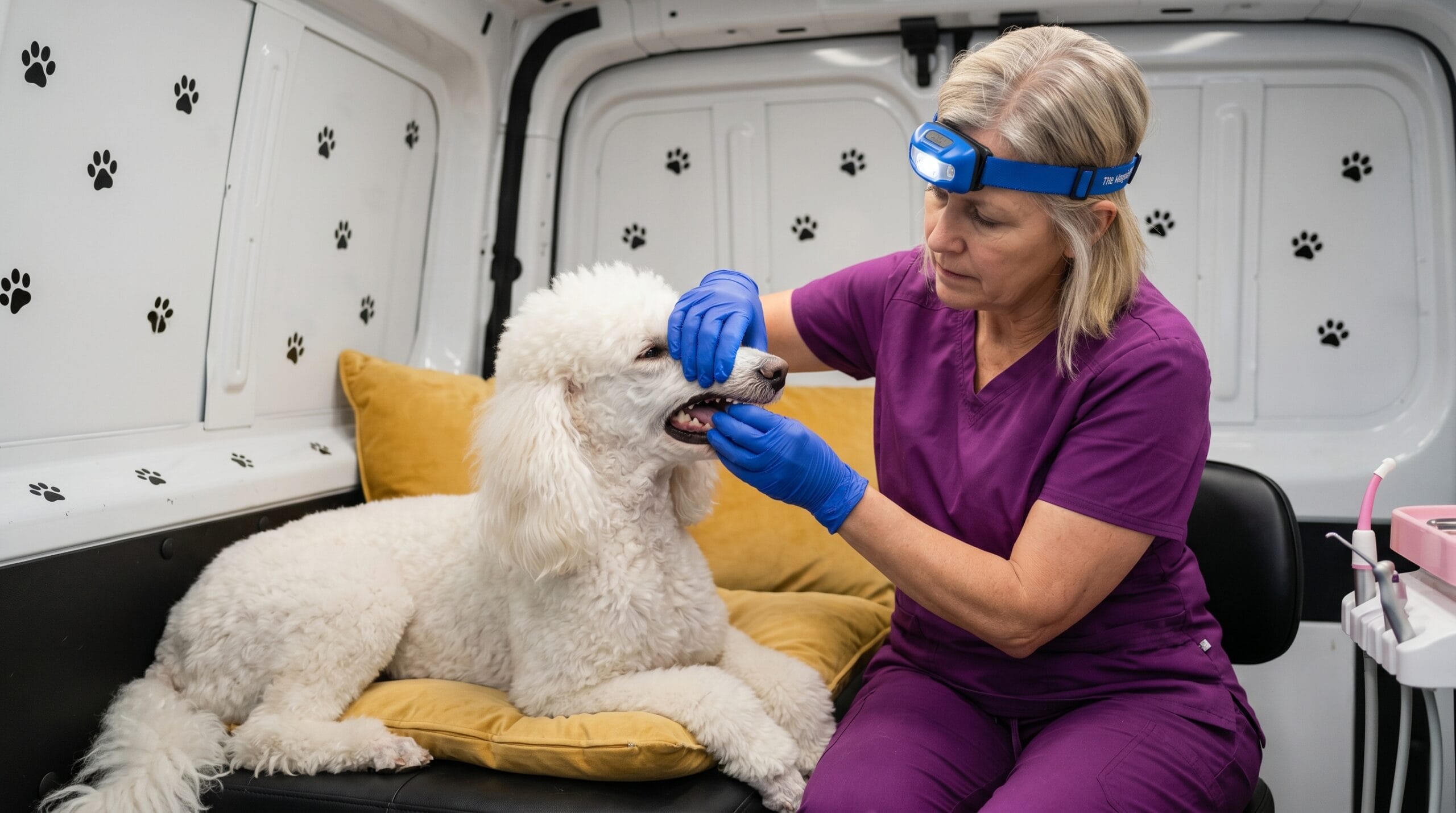
For owners in South Florida and Central Florida, The Magic Paws offers professional mobile dog teeth cleaning that brings the procedure to the pet’s location, which eliminates the stress of travel and clinic environments. Understanding how long a dog dental cleaning takes helps owners plan the appointment without disrupting the rest of the day.
At home, the most valuable complement to professional care is a consistent brushing routine. Starting the habit during puppyhood, specifically during the three- to seven-month window when the permanent teeth are erupting, makes the process significantly easier to maintain long term.
A practical guide on how to brush dog teeth covers technique, product selection, and how to build the habit gradually with a resistant animal. After any professional session, a guide on what to feed your dog after dental cleaning covers what works and what to avoid during the recovery period.
42 teeth, two sets, one chance to get it right. See how regular professional cleaning fits into your dog’s dental care routine. Dog teeth cleaning: what it involves and when to schedule it.
FAQ about dog teeth
How many teeth do puppies have at birth?
Puppies are born with no visible teeth. The first deciduous teeth, typically the incisors, begin breaking through the gums between three and four weeks of age. By six to eight weeks, most puppies have their full set of 28 baby teeth in place.
Can dogs grow back teeth after losing them?
No. Dogs have exactly two sets of teeth in their lifetime: one deciduous and one permanent. Once a permanent tooth is lost, whether from trauma or periodontal disease, nothing grows back in its place. If you notice a loose or missing tooth in an adult dog, a veterinary evaluation is the next step.
What is a retained deciduous tooth in dogs?
A retained deciduous tooth is a baby tooth that does not fall out on schedule as the permanent tooth erupts beneath it. When both teeth share the same space in the jaw, the permanent tooth is forced into an abnormal position. This misalignment creates crowding that accelerates tartar buildup and can lead to bite problems. Toy breeds and brachycephalic animals are most commonly affected, and the usual treatment is extraction of the retained tooth.
What is the carnassial tooth and why does it matter?
The carnassial tooth is the upper fourth premolar, and it functions as the primary shearing tool in a dog’s mouth. Its design allows it to slide past the lower first molar with a cutting action similar to scissors, making it critical for processing tougher food. Because it handles extreme mechanical load regularly, it is also one of the most frequently fractured teeth in dogs. A carnassial fracture often exposes the root canal, which leads to infection and significant pain if left untreated.
How can I tell if my dog has a tooth infection?
Common signs include facial swelling below one eye (often indicating a carnassial abscess), reluctance to chew on one side, excessive drooling, and breath that smells strongly of decay. A dog with a tooth infection will not always display obvious pain behavior. If any of these signs appear, a veterinary examination is necessary.
Are small dog breeds more prone to dental problems?
Yes. Small breeds tend to have teeth that are proportionally larger than their jaw size allows, which causes crowding. Crowded teeth create tight contact points where plaque accumulates faster and is harder to remove. As a result, small dogs typically develop tartar and periodontal disease earlier and more aggressively than larger breeds under the same care conditions.
How often should I brush my dog’s teeth?
Daily brushing is the standard recommendation. If daily is not realistic, aiming for at least three times per week produces a meaningful reduction in plaque accumulation. The key is consistency: brushing every day for a week and then stopping for two weeks is less effective than brushing three times a week without interruption.
At what age should I start caring for my dog’s dental health?
The earlier the better. The window between three and seven months, when the permanent teeth are erupting, is the ideal time to introduce brushing and oral handling. Starting during this period allows the animal to build tolerance for the routine before behaviors are fully established in adulthood.
What happens if a dog’s dental problems are left untreated?
Untreated periodontal disease progresses in stages, from gingivitis to attachment loss to bone destruction. At advanced stages, it causes chronic pain, tooth loss, and systemic complications. The WSAVA Global Dental Guidelines document the connection between oral bacteria and cardiovascular, renal, and hepatic involvement in companion animals. Early intervention consistently produces better outcomes at lower cost.
How does professional dental cleaning differ from brushing at home?
Brushing removes surface plaque before it hardens. Professional cleaning removes tartar that has already mineralized, scaled from tooth surfaces above and below the gumline. These two interventions address different stages of the same process and are not interchangeable. Brushing reduces the frequency at which professional cleaning is needed; it does not replace it.