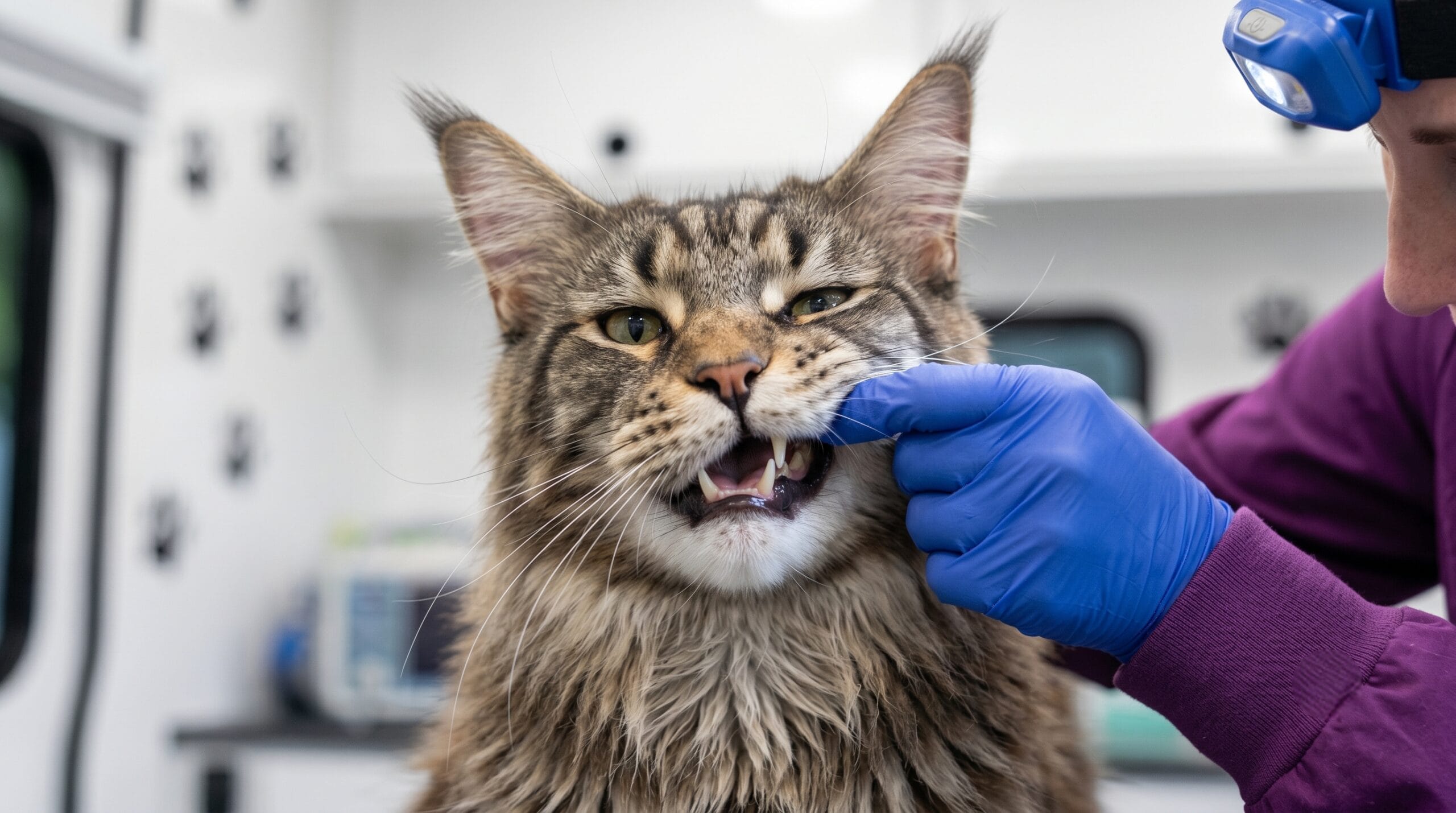

Most owners know that brushing a cat’s teeth is something they should be doing. The problem is rarely knowledge: it is cooperation. A cat that clamps its jaw shut, backs away, or simply refuses to stay still turns a two-minute routine into a small battle, and most people stop trying after the first few attempts.
Learning how to brush cat teeth correctly changes that dynamic. The right technique, the right tools, and the right approach to introducing the habit make a real difference, not just for your cat’s teeth, but for how sustainable the routine becomes for you.
Feline dental disease is far more common than most owners realize. Plaque starts forming on teeth within hours after eating, and without regular removal it progresses into something a toothbrush alone cannot undo. The consequences go beyond bad breath: advanced periodontal disease in cats has been linked to damage in organs that have nothing to do with the mouth.
This guide walks through everything you need to build a brushing routine that works. This includes what tools to use, how to introduce brushing to a resistant cat, how often to do it, and when home care is no longer enough on its own.
Why does brushing your cat’s teeth matter?
Brushing removes plaque before it hardens into tartar, preventing the bacterial buildup that leads to gingivitis, periodontal disease, and tooth loss. It is the single most effective form of cat dental care at home and the foundation of long-term oral health for any feline.
Cats are perfect at hiding discomfort. A cat with significant plaque buildup below the gumline may continue eating normally, grooming as usual, and showing no obvious signs of pain, right up until the damage becomes severe. That behavioral masking is one of the reasons feline dental disease is so consistently underdiagnosed.
According to the Cornell University College of Veterinary Medicine, periodontal disease is one of the most common conditions in adult cats, affecting the majority of felines by age three. The progression is almost always silent. Owners often notice something is wrong only when the cat stops eating or starts showing visible discomfort, at which point significant damage has already occurred.
What happens when plaque turns into tartar
Plaque is a soft bacterial film that forms on teeth shortly after eating. At this stage, it can be removed by brushing. Within 24 to 72 hours, however, minerals from saliva begin to bond with the plaque, and it calcifies into tartar, a hard yellowish or brown deposit that adheres to the enamel surface. Once tartar forms, no toothbrush can remove it: only a professional cleaning can.
As tartar accumulates at and below the gumline, bacteria penetrate the gingival margin and cause inflammation. That is gingivitis: swollen, red, often tender gums that bleed on contact. Left untreated, gingivitis progresses into feline periodontal disease, the most severe form of gum disease in cats, where bacteria attack the ligaments and bone structure anchoring the teeth. At that point, even well-preserved teeth can become loose and require extraction.
How dental disease affects more than just the mouth?
The connection between cat oral hygiene and systemic health is well documented. Bacteria from infected gum tissue can enter the bloodstream and travel to distant organs. The kidneys and heart are the most frequently affected: chronic oral infection has been associated with kidney disease and changes in cardiac tissue in cats.
The Cornell University College of Veterinary Medicine notes that the inflammatory processes triggered by periodontal disease can contribute to systemic organ damage over time. Reducing oral bacterial load through consistent home brushing is one of the most accessible ways to lower that risk. Prevention here is not just about teeth.
What do you need to brush a cat’s teeth?
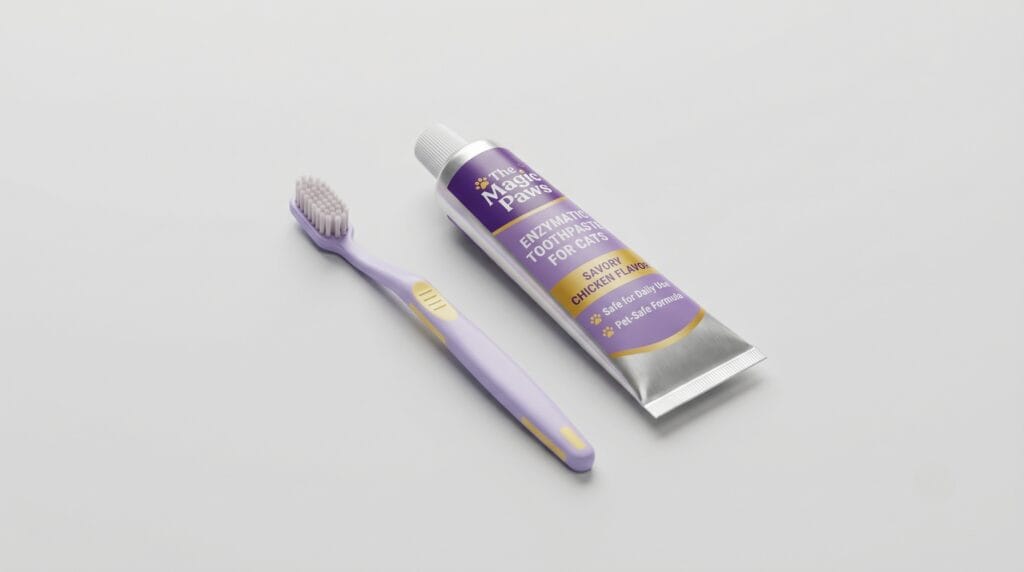
You need three things to brush your cat’s teeth at home: a toothbrush sized for cats, a pet-safe toothpaste with enzymatic formula, and a calm, consistent environment. Gathering the right materials before introducing any brushing attempt makes the process more predictable for your cat and easier to repeat.
The Veterinary Oral Health Council (VOHC) maintains an updated list of approved products for cats, including toothpastes and dental treats that have been independently tested for efficacy. The American Veterinary Dental College (AVDC) also recognizes daily brushing as the most effective form of at-home plaque control for companion animals. Cross-referencing any product against the VOHC list before purchasing is a simple step that removes the guesswork.
Choosing the right toothbrush for cats
Three types of applicators are commonly used for cat teeth cleaning at home. Each one suits a different level of cat cooperation and owner comfort:
| Type | Advantage | Best for |
| Cat-specific toothbrush | Angled head, soft bristles designed for feline anatomy | Cats that already tolerate mouth handling |
| Finger brush | Fits over the fingertip, gives more tactile control | Cats being introduced to brushing for the first time |
| Gauze wrapped around finger | Softest option, least intimidating | Very resistant cats or initial desensitization phases |
None of these options requires expensive equipment. The most important characteristic across all three is soft bristles or texture, never hard. Hard bristles cause gum abrasion and make the experience uncomfortable, which increases resistance over time.
Why human toothpaste is not safe for cats
Human toothpaste must never be used on a cat’s teeth. The two primary reasons are fluoride and xylitol: fluoride is toxic to cats in the concentrations found in standard toothpastes, and xylitol, a sweetener present in many products, is acutely toxic to pets. Even a small amount can cause serious harm.
Sodium lauryl sulfate, the foaming agent in most human formulas, is also an irritant for cats. Pet-safe enzymatic toothpaste is specifically formulated without these compounds and uses enzymes that continue breaking down plaque even after brushing has stopped. Look for the VOHC Seal of Acceptance on the label: it confirms the product has been evaluated and meets clinical standards for at-home dental care.
How to brush your cat’s teeth step by step
Brushing a cat’s teeth successfully follows a clear sequence: position the cat securely, lift the upper lip to expose the outer surface of the teeth, apply a small amount of pet-safe toothpaste to the brush, and use short circular strokes along the gumline. The entire process, once the cat is accustomed, takes under two minutes.
For cats that have never been brushed before, the sequence below introduces each element separately before combining them. Skipping stages is the most common reason the process fails.
- Start with touch: spend a few days simply touching your cat’s muzzle and lips with your finger. No toothbrush, no toothpaste. The goal is for your cat to accept facial handling as a neutral experience.
- Introduce the taste: let your cat lick a small amount of pet-safe enzymatic toothpaste off your fingertip. Most formulas come in chicken or fish flavors. This builds a positive association with the taste before the brush enters the picture.
- Add the finger brush: once your cat accepts the toothpaste, slide the finger brush onto your fingertip and gently rub it along the outer surface of the teeth. Do this for a few seconds. Stop before your cat shows signs of stress.
- Transition to the toothbrush: replace the finger brush with a cat-specific toothbrush, keeping the same gentle circular motion along the gumline. Focus on the outer surface of all teeth, particularly the upper back molars and canines, where tartar tends to accumulate first.
- Reward consistently: offer a treat, play, or affection immediately after every session. Positive reinforcement is what makes the routine sustainable.
The inner surfaces of the teeth do not require brushing: the tongue naturally cleans that area. Focusing on the outer surface at the gumline is where the most clinical impact happens.
How often should you brush your cat’s teeth?
Daily brushing is the clinical recommendation for cats, since plaque begins mineralizing into tartar within 24 to 72 hours. A minimum of three sessions per week can still offer meaningful protection when daily brushing is not achievable, though the risk of tartar formation increases as frequency drops.
The biological reason frequency matters is straightforward: the window between plaque formation and calcification is short. A missed day does not create permanent damage, but a consistently irregular routine allows tartar to establish itself incrementally, and once that happens, home care can only prevent further accumulation, not reverse what is already there.
Building a toothbrushing routine for your pet that fits naturally into the day, whether tied to feeding time or a calm evening moment, is more practical than attempting to follow a rigid schedule.
Cats respond well to predictable cues. A brushing session that happens at the same time, in the same place, with the same sequence of steps becomes progressively easier to complete as the animal learns what to expect.

What if your cat refuses to be brushed?
Most cats that resist toothbrushing are not inherently uncooperative: they have simply not been desensitized to the process. A graduated introduction over one to three weeks, where each stage is only advanced when the cat is fully relaxed in the current one, resolves resistance in the majority of cases without force or restraint.
For cats that cannot tolerate any form of direct brushing even after a full desensitization attempt, cat teeth cleaning at home can still be supported through approved alternatives.
The VOHC accepted products list for cats includes options beyond the toothbrush: dental treats, water additives, and dental wipes that carry the VOHC Seal of Acceptance, confirming they have been evaluated for clinical efficacy. None of these alternatives replaces brushing entirely, but they contribute meaningfully to plaque control when used consistently.
What does not help is forcing the interaction. A cat that has been restrained against its will during a brushing attempt will associate the experience with stress, making every subsequent session harder. If the cat is pulling away, turning its head, or vocalizing, stop the session immediately. Ending on a calm moment, even if no brushing happened, preserves the positive association built in previous sessions.
Learn what a professional cat dental cleaning looks like.
When is brushing at home not enough?
Brushing at home prevents plaque from becoming tartar, but it cannot remove tartar that has already formed. Once calcified deposits are established at or below the gumline, the signs become more visible: persistent bad breath that does not improve with brushing, red or swollen gums, difficulty chewing, excessive drooling, or a tooth that appears darker or feels loose.
When these signs of dental problems are present, home care is no longer sufficient to address what is already there. A professional cleaning can remove tartar mechanically and assess the extent of tissue damage beneath the gumline. Waiting and continuing to brush in this scenario does not resolve the underlying condition: it only manages the surface.
The reasons to schedule a dental cleaning go beyond visible symptoms. Even cats with no obvious signs of disease can have significant subgingival buildup that only a professional examination can detect. Combining routine home brushing with periodic professional cleanings provides a level of protection that neither approach achieves alone.
For cats in Florida, The Magic Paws offers anesthesia-free dental cleaning as a preventive option for eligible animals. The service uses Senses Therapy, a proprietary protocol that incorporates aromatherapy, music therapy, chromotherapy, and massage, to keep cats calm throughout the procedure without sedation. You can learn more about the cat dental cleaning process and what to expect before scheduling.
The hidden dangers of poor cat oral health extend well beyond the mouth, and the connection between untreated periodontal disease and systemic organ damage is a documented clinical reality. Regular dental checkups, whether at a veterinary clinic or through a professional mobile service, are an essential part of responsible feline care, not an optional upgrade.
Is it too late to start brushing your cat’s teeth?
It is never too late to start brushing a cat’s teeth, but the starting point matters. Adult cats with a history of tartar accumulation should be seen by a veterinarian before beginning a home brushing routine. Brushing over established tartar does not remove it, and if the gums are already inflamed, the bristle contact can be painful, which reinforces resistance rather than building tolerance.
Once a professional cleaning has cleared the existing tartar and the cat has been cleared for home care, brushing becomes genuinely preventive again. From that point, the routine works as intended: removing fresh plaque before it calcifies, rather than working against an accumulation that is already locked in place.
The best time to start a cat’s brushing habit is during kittenhood, when the animal is most receptive to new experiences and mouth handling. The second best time is today, regardless of the cat’s age.
Older cats absolutely can learn to accept the routine. The desensitization process may take longer, and progress may be slower than with a kitten, but it remains achievable. Patience and consistency matter more than starting point.
Supporting that routine with regular dental check-ups and periodic professional cleanings gives any cat, regardless of age, the best possible foundation for oral health over the long term.
Brushing at home is a great start. When your cat is ready for a deeper clean, The Magic Paws brings professional cat dental cleaning to your door, without anesthesia. Schedule your cat’s first cleaning today.
FAQ about how to brush a cat’s teeth
Can I use human toothpaste to brush my cat’s teeth?
No. Human toothpaste contains fluoride and xylitol, both of which are toxic to cats. Even small amounts can cause serious harm. Always use a pet-safe toothpaste with the VOHC Seal of Acceptance, available in flavors cats find palatable, such as chicken or fish.
How long does it take for a cat to get used to toothbrushing?
The adjustment period ranges from a few days to a few weeks, depending on the individual animal’s temperament and handling history. The key is to advance each stage of the desensitization process only when the cat is fully relaxed in the current one. Forcing the pace is the primary cause of prolonged resistance.
What is the best toothpaste for cats?
No single brand can be universally recommended, since individual cats respond differently to flavors and formulas. The reliable criterion is the VOHC Seal of Acceptance: it confirms the product has been independently evaluated for plaque control. The VOHC accepted products list is updated regularly and includes all currently approved cat toothpastes.
Can cats get periodontal disease?
Yes. Feline periodontal disease is one of the most frequently diagnosed conditions in cats, with prevalence estimates suggesting the majority of adult felines show some degree of gum involvement by age three, according to data from Cornell University. Left untreated, it progresses to bone loss, tooth extraction, and potential systemic organ damage.
Is it okay to brush only the outside of my cat’s teeth?
Yes. The inner surface of the teeth is naturally cleaned by the tongue, so the brushing effort should focus on the outer surface, particularly at the gumline where plaque and tartar accumulate most heavily. Concentrating on the outside of the upper back molars and canines covers the highest-risk areas first.
What can I use instead of a toothbrush for my cat?
Finger brushes, gauze wrapped around a fingertip, and dental wipes are all valid options for cats that cannot tolerate a standard toothbrush. A finger toothbrush for cats, in particular, gives the owner more tactile control during the early stages of the routine, which tends to reduce the cat’s anxiety. For broader plaque control, VOHC-approved dental treats and water additives can supplement the routine.
How do I know if my cat has dental disease?
Observable signs include persistent bad breath, red or swollen gums, difficulty chewing, excessive drooling, pawing at the mouth, and teeth that appear darker than normal or feel loose. Because cats mask discomfort well, a professional examination is the only way to assess what is happening below the gumline.
At what age should I start brushing my cat’s teeth?
As early as possible. Kittens are most receptive to mouth handling and adapt to the brushing routine with relatively little resistance. Adult and senior cats can also be introduced to the habit, but the desensitization process tends to be slower. Starting at any age is better than not starting at all.
How much does a professional cat dental cleaning cost?
Cost varies by provider, region, and the type of cleaning offered. Anesthesia-based procedures at veterinary clinics carry different pricing than anesthesia-free preventive cleaning services. The best approach is to contact the provider directly to understand what is included. The Magic Paws offers transparent pricing for its cat dental cleaning service in Florida.
Does anesthesia-free cat dental cleaning actually work?
Yes, when performed by a qualified professional and when the cat meets the eligibility criteria for the procedure. The approach relies on a structured behavioral desensitization protocol rather than sedation. The Magic Paws uses Senses Therapy, which combines aromatherapy, music therapy, chromotherapy, and massage, to keep cats calm throughout the process. The result is a preventive cleaning that removes surface plaque and tartar without the physiological risks associated with general anesthesia.