How many teeth do cats have? Is one of those questions that seems simple until you start looking for a real answer. After all, most cat owners have never examined their cat’s mouth closely enough to count, and many are surprised when they learn the actual number.
It turns out that feline dental anatomy is more structured than most people realize. These animals have two separate sets of teeth over their lifetime, and each set serves a specific purpose matched to the stage of life they are in.
Understanding how your cat’s teeth are organized gives you a much better foundation for recognizing what is normal, what is not, and when professional care actually matters. That awareness is what separates owners who catch problems early from those who notice them only after they become serious.
This article walks through how many teeth cats have at each stage, what each type does, how the transition from kitten to adult works, and what keeps all those teeth functioning well for as long as possible.
How many teeth do cats have?
Adult cats have 30 permanent teeth. Kittens are born without teeth and develop a set of 26 deciduous teeth, commonly called baby teeth, before those are gradually replaced by the full adult set. There are 16 teeth on the upper jaw and 14 on the lower jaw that make up the adult dentition.
To understand what that looks like in practice, here is how the numbers break down by tooth type:
| Tooth type | Kittens (deciduous) | Adult cats (permanent) | Primary function |
| Incisors | 12 | 12 | Grooming, picking up small food pieces |
| Canines | 4 | 4 | Gripping, holding prey |
| Premolars | 10 | 10 | Shearing meat |
| Molars | 0 | 4 | Crushing harder material |
| Total | 26 | 30 |
The 4 molars in the adult set are the key difference. Kittens do not develop molars at all, since these teeth only emerge as part of the permanent dentition. That is one reason why the final months of the teething process, between 3 and 6 months of age, include such a visible change in the cat’s bite and jaw structure.
That’s why scheduling regular cat dental cleanings is one of the most important habits a cat owner can build. Keeping all 30 teeth functional requires ongoing care, not occasional attention.
What are the different types of cat teeth and what do they do?
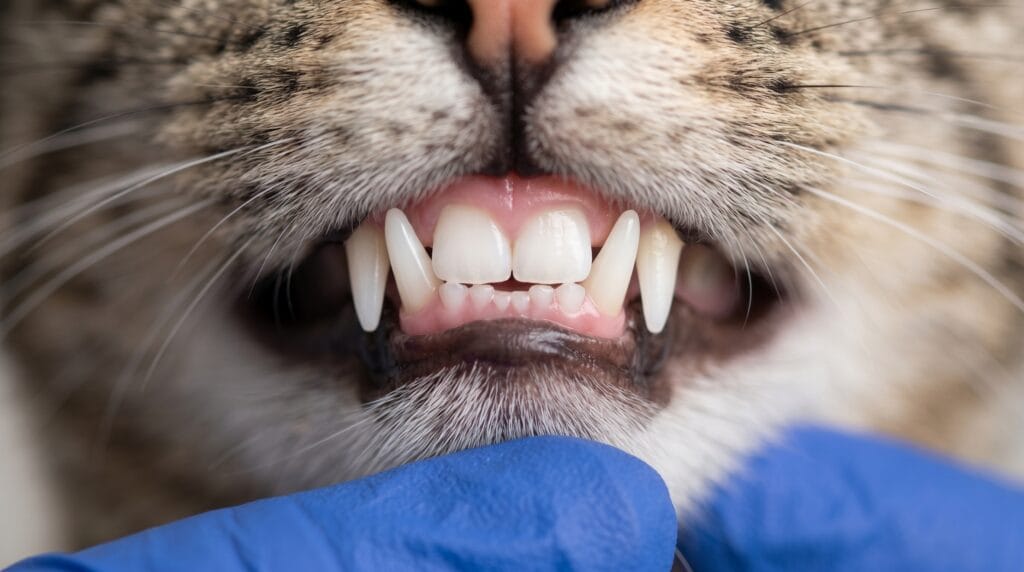
Cats have four types of teeth: incisors, canines, premolars, and molars. Each type occupies a specific position in the jaw and performs a distinct function. Together, they make up the complete toolkit of an obligate carnivore, an animal whose diet depends entirely on meat.
Incisors
Are the 12 small teeth at the very front of the mouth, 6 on top and 6 on the bottom.
They handle precision tasks: pulling meat from bone, self-grooming, and manipulating small objects. They are not the strongest teeth in the mouth, but they are among the most frequently used.
Canines
Are the four long, pointed teeth on either side of the incisors. They are the most recognizable part of feline dentition and the teeth most associated with hunting behavior. In practice, canines grip prey and deliver the killing bite.
In domestic cats, they still carry the full structural depth of a predator’s tooth, even when the closest thing to prey is a toy mouse.
Premolars
The ten teeth are situated behind the canines on the sides of the jaw because they function as the primary shearing tool.
Cats use a scissor-like lateral motion to slice through food rather than chewing the way humans or dogs do. The carnassial pair, the largest premolars on the upper and lower jaw, does most of that work.
Molars
The four molars at the very back of the jaw are in charge of crushing this type of tooth, which is only found in adult cats. They are smaller than the premolars and less visually prominent, but their presence marks the transition from kitten to fully developed adult dentition.
How do cat teeth develop from kitten to adult?
Cats go through two distinct stages of dental development: a deciduous phase lasting from birth to approximately 6 months and a permanent phase that begins around 3 months of age and continues through young adulthood.
The entire transition follows a predictable sequence tied to specific developmental windows.
- Birth: Kittens are born without any visible teeth. The deciduous tooth buds are forming under the gum tissue, but nothing has erupted yet.
- 2 to 3 weeks: The first teeth emerge. Incisors typically appear first, followed shortly by the canines. At this stage, kittens are still nursing, and the teeth support the shift toward solid food.
- 8 weeks: The full set of 26 deciduous teeth is in place. This is the age most kittens go home with new families, and it is the first time most owners get a look at a complete kitten mouth.
- 3 to 4 months: The permanent incisors begin pushing through and the deciduous incisors start loosening. At this point the cat may swallow baby teeth without the owner ever noticing, which is normal.
- 4 to 6 months: Canines and premolars follow in sequence. The molars, exclusive to the adult set, emerge during this window as well. By 6 months, most cats have all 30 permanent teeth in place.
One complication worth knowing: retained deciduous teeth. When a baby tooth does not fall out on schedule, it can sit next to the erupting permanent tooth and cause crowding, abnormal positioning, and accelerated plaque accumulation.
Retained deciduous teeth are more common in certain breeds but can happen in any cat. They typically require removal if they do not resolve on their own.
What happens to cat teeth as they get older?
Senior cats are not destined to lose teeth as a natural consequence of aging. Tooth loss in older cats is most commonly the result of dental disease that progressed without intervention, not a biological inevitability. The distinction matters because it changes how owners should think about prevention throughout their cat’s life.
The two conditions most responsible for tooth loss in senior cats are periodontal disease and tooth resorption. Periodontal disease destroys the bone and ligament structures that anchor the tooth.
Once that support is gone, the tooth cannot remain stable regardless of how healthy the crown looks from the outside. Tooth resorption, formally known as feline odontoclastic resorptive lesions (FORLs), involves the gradual breakdown of tooth structure from within. Both conditions are progressive, largely painless in early stages, and frequently invisible to owners.
According to Cornell University, between 50% and 90% of cats over 4 years old develop some form of feline dental disease. That window begins well before most owners start thinking about senior care.
A cat that reaches its first birthday without any dental intervention has already spent a full year accumulating plaque and beginning the slow process of mineralization into tartar.
The cats least likely to experience tooth loss in old age are those that received consistent professional cleaning throughout their lives, starting young and maintaining a regular cadence.
This is the exclusive angle most dental content ignores: tooth loss in senior cats is not about what happens at age 12. It is about what did or did not happen at age 2, 4, and 6. Cats that receive care for cat dental cleaning in Florida early and consistently build a track record of clean tissue that is far more resistant to disease progression.
📣 Dental disease in cats often goes unnoticed for years. Learn more about the silent threat in your cat’s mouth and what signs to watch for.
What are the signs that your cat’s teeth need attention?
Bad breath is usually the first sign owners notice, but by the time it is obvious enough to catch attention, the underlying problem has typically been developing for months.
Cats are instinctively wired to conceal pain and weakness, which means dental disease in cats progresses further before becoming visible than it does in most other pets.
The signs to watch for include:
- Persistent bad breath that does not resolve with normal hydration or eating
- Red, swollen, or bleeding gums along the gumline
- Yellow or brown buildup on the tooth surface, particularly at the base near the gum
- Difficulty chewing, dropping food, or chewing only on one side
- Excessive drooling or drooling that has changed in frequency
- Pawing at the mouth or rubbing the face against surfaces
- Reduced appetite or reluctance to eat hard food
None of these signs are emergencies on their own, but any one of them warrants a closer look. Cats that show multiple signs simultaneously are typically dealing with disease that has already progressed past the early stages.
Annual dental checkups help catch problems before they become visible. That is especially true for the silent threat in your cat’s mouth: subclinical disease that an owner would never detect at home but that a trained eye can identify during a professional evaluation.
How do you keep all 30 of your cat’s teeth healthy?
Keeping your cat’s full set of 30 teeth healthy into old age requires two things working together: a consistent home care routine and regular professional cleaning. Neither replaces the other.
At home, the most effective option is tooth brushing with a toothbrush and toothpaste designed for cats. The earlier in life brushing starts, the more cooperative most cats become.
Dental treats, water additives, and enzymatic gels can support plaque control between brushings, but they do not remove tartar that has already mineralized onto the tooth surface.
Professional cleaning handles what home care cannot. Tartar below the gumline requires mechanical removal, and that can only be done by a trained technician with the right equipment.
The frequency that works best for most cats is once per year, though cats with a history of periodontal disease or certain anatomical predispositions may benefit from more frequent sessions.
For cat owners across the state, cat dental cleaning in Florida is now more accessible than ever, with mobile services that come directly to your door. If you live in the region, cat dental cleaning in Central Florida can be done without sedation, in a calm and stress-free environment.
The Magic Paws offers mobile pet dental care in Central Florida that fits into your routine without the stress of a clinic visit. Every session follows the Senses Therapy protocol, a proprietary approach that combines aromatherapy, music therapy, chromotherapy, and massage to keep cats calm and cooperative throughout the procedure.
The result is a thorough cleaning without sedation, delivered inside the white Nissan NV200 van that parks directly in front of your home.
Is it too late to start?
Prevention works best when it starts early, but it has value at every stage. A cat that has never had a professional cleaning at age 5 is not beyond help. Starting consistent care now changes the trajectory of what the next 10 years look like for that animal.
The question most owners should ask is not whether dental care matters, but how long they can afford to wait before it does. Plaque forms within 24 hours of a cleaning.
Tartar mineralizes in days. The structures that support your cat’s teeth respond to accumulated neglect slowly and silently, and the damage accumulates long before any sign becomes visible.
Thirty teeth. Two years of age. That is when consistent prevention makes the biggest difference. Every year of professional care after that is another year of protection built into the tissue that holds every one of those teeth in place.
Your cat has 30 teeth worth protecting. Book a sedation-free cat dental cleaning and keep every single one healthy.
FAQ
Do cats have more teeth than dogs?
No. Adult cats have 30 permanent teeth, while adult dogs have 42. Kittens have 26 baby teeth compared to 28 in puppies. Despite having fewer teeth, cats have a highly specialized dental structure built for their role as obligate carnivores, with canines and premolars designed for gripping and shearing.
How many teeth do kittens have?
Kittens have 26 deciduous teeth, also called baby teeth. They include 12 incisors, 4 canines, and 10 premolars. Kittens do not develop molars until their adult teeth come in. The full baby set is usually present by 8 weeks of age.
Do cats lose teeth as they get older?
Tooth loss is not a normal part of aging, but it becomes more common in senior cats with untreated dental disease. Conditions like periodontal disease and tooth resorption can destroy the structures that hold teeth in place over time. Regular professional cleanings throughout a cat’s life significantly reduce this risk.
What are the signs of dental disease in cats?
Bad breath is often the first sign owners notice. Others include red or swollen gums, difficulty chewing, dropping food, drooling, and pawing at the mouth. Because cats instinctively hide pain, dental disease is frequently advanced by the time it becomes visible. Annual dental checkups help catch problems early.
How often should cats get their teeth cleaned professionally?
Most cats benefit from a professional dental cleaning once a year. Cats with a history of dental disease, retained baby teeth, or certain breeds prone to oral conditions may need more frequent care. Starting cleanings early in life and maintaining consistency is what prevents the most serious problems.
Can cats get their teeth cleaned without anesthesia?
Yes. Anesthesia-free dental cleaning is an option for cats that need preventive care and are not dealing with severe disease, loose teeth, or conditions requiring surgical intervention. The Magic Paws specializes in sedation-free cat dental cleaning, using gentle handling and the Senses Therapy protocol to keep cats calm. Visit our service page for pricing details.
What happens if cat dental disease is left untreated?
Untreated dental disease progresses from gingivitis to periodontitis, causing irreversible damage to the bone and tissue supporting the teeth. In advanced cases, bacteria from the mouth can enter the bloodstream and affect the heart, kidneys, and liver. According to Cornell University, between 50% and 90% of cats over 4 years old develop some form of dental disease.
Do indoor cats need dental cleanings too?
Yes. Dental disease affects indoor and outdoor cats equally. Diet, genetics, and the absence of regular cleaning all contribute to plaque and tartar buildup regardless of lifestyle. Indoor cats often live longer, which means more years of potential dental disease accumulation if care is not consistent.
How can I check my cat’s teeth at home?
Lift your cat’s upper lip gently and look for yellow or brown buildup along the gumline, redness, swelling, or any teeth that appear loose or broken. Check both sides and the back te