Learning how to toothbrush a dog? It is one of the most useful things you can do for their long-term health. It takes less than two minutes, requires no special training, and makes a real difference over time. Yet most dog owners either skip it entirely or give up after the first attempt.
That is understandable. Dogs do not naturally sit still for oral care. The first sessions can feel awkward, and without a clear technique, it is challenging to know if you are doing anything useful at all.
This article covers everything you need to start brushing your dog’s teeth correctly: what tools to use, how to hold the brush, how often to do it, and what to do when your dog refuses.
It also explains what brushing cannot do on its own and why professional cleaning is a factual part of any complete dental routine. So, if you have been putting this off, this is the guide that makes it practical.
What actually happens inside your dog’s mouth every day?
Every time your dog eats, bacteria in their mouth mix with saliva and food particles to form a thin, sticky layer on the surface of their teeth.
That layer is plaque. It starts forming within hours of a meal and, if not removed regularly, triggers a chain of events that leads to periodontal disease. Brushing interrupts that cycle before it advances.
Plaque becomes tartar in under 48 hours
Plaque is soft and can be removed with a toothbrush. The problem is the window for removal is short. Within 24 to 48 hours, minerals in the saliva bind to plaque and harden it into tartar, also called calculus.
Once that happens, no brush can remove it. The surface of the tooth changes: tartar is porous and rough, which means it attracts even more bacteria and makes future buildup faster.
That hardened layer is what you see as the yellowish or brownish crust along the gumline, especially on the back teeth. It does not go away with brushing. It requires professional cleaning tools to be removed safely.
Tartar triggers gum disease at the gumline
Once tartar accumulates along the gumline, the surrounding tissue becomes irritated and inflamed. This early stage is called gingivitis. The gums redden, swell, and may bleed when touched. At this stage, the damage is still reversible.
Without intervention, gingivitis progresses to periodontal disease, a bacterial infection that destroys the tissue and bone supporting the teeth. According to VCA Animal Hospitals, approximately 80% of dogs over the age of three show signs of periodontal disease. Most of them are not in visible pain, which is why the condition is so frequently missed.
Periodontal disease reaches beyond the mouth
Periodontal disease does not stay in the mouth. The bacteria from infected gum tissue can enter the bloodstream and travel to other organs.
Research has linked severe periodontal disease in dogs to changes in kidney, liver, and heart tissue. The connection is not fully understood in every detail, but the direction of the evidence is consistent: untreated dental disease creates systemic risk. Keeping the mouth clean is not just about teeth. It is about the whole animal.
What do you actually need to brush your dog’s teeth?
To brush your dog’s teeth, you need three things: a canine toothbrush, enzymatic toothpaste formulated for dogs, and a small treat. Nothing else is required to get started. The right combination of these tools makes the routine easier for both you and your dog.
Here is what each item does and why it matters:
| Item | Purpose | Key rule |
| Canine toothbrush | Removes plaque mechanically from tooth surfaces | Never use a human toothbrush with hard bristles |
| Enzymatic toothpaste | Chemically reduces plaque; safe to swallow | Never use human toothpaste |
| Small treat | Reinforces positive association with the routine | Give after the session, not during |
Human toothpaste contains fluoride and xylitol, both toxic to dogs even in small amounts. Dog-formulated toothpaste is designed to be swallowed and comes in flavors like poultry, beef, or vanilla mint, which makes the experience more tolerable for the dog.
The enzymatic formula does not just add flavor: it actively reduces plaque through a chemical reaction, even in areas the brush does not fully reach.
Which toothbrush is the right choice for your dog?
The best toothbrush for dogs depends on your dog’s size, the shape of their mouth, and how tolerant they are of the process.
Three main types are commonly used: double-headed and angled brushes, finger brushes, and soft bristle brushes. Each has a different use case, and choosing the wrong one makes the routine harder than it needs to be.
You can find more context about full dog dental hygiene at home in our related content.
Double-headed and angled brushes reach further
Double-headed brushes have heads on both ends of the handle and are designed to clean multiple tooth surfaces at once. The angled design lets the bristles reach the back molars, where plaque is hardest to remove and tartar accumulates fastest.
These brushes work best for medium and large dogs with enough space in the mouth to maneuver the tool. For owners who want maximum coverage in minimum time, an angled double-headed brush is the most efficient option. The shape does most of the positioning for you.
Finger brushes offer control with limitations
A finger brush fits over the tip of your index finger and lets you feel exactly where you are applying pressure. For first-time brushers, that tactile feedback makes it easier to avoid pressing too hard or missing areas.
The limitation is reached. A finger brush cannot extend as far into the back of the mouth as a handled brush can. It also means your finger is closer to the dog’s teeth, which is not ideal during the early stages when the dog is still adjusting. Use thumb brushes to introduce the sensation, then transition to a handled brush once the dog is comfortable.
Soft bristle brushes protect sensitive gums
For dogs with visible gum inflammation, bleeding gums, or existing gingivitis, a soft bristle brush is the appropriate choice. The brushes flex and bend under light pressure, which reduces the risk of further irritating already sensitive tissue.
Soft bristle brushes are also the right option for senior dogs, who are more likely to have some degree of gum sensitivity by the time they reach middle age. If your dog flinches when the brush makes contact, move to a softer option before anything else.
How do you brush your dog’s teeth step by step?
To brush your dog’s teeth correctly, position the brush at a 45-degree angle to the gumline and use short circular strokes moving from the back teeth to the front. Work on the outer surfaces first, spend about 30 seconds per side, and keep the total session under two minutes. Consistency matters more than duration.
Follow this sequence to make each session effective:
- Wash your hands and prepare the toothbrush with a pea-sized amount of enzymatic toothpaste.
- Let your dog sniff and lick the toothpaste from your finger before introducing the brush.
- Lift the upper lip on one side to expose the outer surface of the teeth.
- Place the brush at a 45-degree angle to the gumline, as recommended by Colorado State University’s Veterinary Teaching Hospital.
- Use short circular strokes, moving from the back molars toward the front teeth.
- Repeat on the other side. Then move to the lower teeth using the same motion.
- Reward your dog immediately after with a treat and verbal praise.
Focus on the outer surfaces. Dogs rarely develop significant plaque buildup on the inner surfaces because the tongue helps keep those areas cleaner. The outer surfaces, especially the upper back molars, are where tartar forms first and fastest.
What if your dog refuses to let you near their mouth?
If your dog pulls away, snaps, or freezes when you bring a toothbrush near their mouth, the solution is not persistence. It is a gradual desensitization process that separates each element of the routine and introduces them one at a time, over days or weeks.
Rushing this stage causes setbacks. Going slowly gets you there faster.
Finger and toothpaste first, no brush yet
Start by putting a small amount of enzymatic toothpaste on your fingertip and letting your dog lick it. No brushing, no contact with the gums. Just flavor and association.
Once your dog accepts this without tension, move to touching the outside of their lips with your finger while they lick the paste. Hold this stage for several sessions until the dog does not pull away.
The goal is to build a connection between your hand near their mouth and something they enjoy. That connection is what makes every next step easier.
Gauze before the brush, texture before bristles
After your dog accepts finger contact with the toothpaste, wrap a small piece of gauze around your finger and gently rub the outer surface of a few teeth. The gauze removes some plaque and introduces the sensation of friction, which is very different from the softness of a fingertip.
This step prepares the dog neurologically for the toothbrush. The sensation of bristles on the gumline is the part most dogs resist. Gauze narrows that gap. Once the dog tolerates the gauze without pulling back consistently, the transition to a soft bristle brush becomes far less confrontational.
Positive reinforcement turns routine into ritual
Timing the reward correctly is what makes the difference between a dog that tolerates brushing and one that starts looking for the toothbrush on their own.
Give the treat within three seconds of finishing the session, every single time. Do not use food as a bribe during brushing as that teaches the dog to hold out. Use it only because of good behavior after. Pair the treat with the same short phrase each time so the dog begins to predict what is coming. Most dogs reach a point of comfortable tolerance within two to four weeks of daily sessions.
📣 Brushing gets you far. But it does not reach below the gumline, where most dental disease starts. The Magic Paws brings professional, anesthesia-free cleaning to your home across South Florida and Orlando. Book your dog’s cleaning today.
How often should you brush your dog’s teeth?
Our recommendation is brushing your dog’s teeth daily. Three times per week is the minimum frequency needed to keep plaque from mineralizing into tartar.
Below that threshold, brushing still helps but is not enough on its own to prevent progressive buildup in most dogs. Daily brushing is the standard for a reason: plaque starts forming within hours and hardens within 48.
Does brushing frequency change depending on your dog?
Yes, brushing frequency is not the same for every dog. Anatomy, age, and existing dental conditions all affect how often you need to brush to stay ahead of plaque buildup.
Daily brushing is the baseline for all dogs, but some profiles require closer attention and potentially more frequent sessions.
For dogs already managing professional pet dental cleaning in Tampa or other parts of Florida, the veterinarian or dental technician may give specific guidance on home brushing frequency based on what they observed during the cleaning.
Small and toy breeds need more attention
Small and toy breeds have the same number of teeth as large dogs but in a significantly smaller space. Their teeth are closer together, which creates more areas where plaque accumulates and fewer angles the brush can reach effectively.
This means plaque builds faster in small breeds even with the same brushing frequency. Owners of small dogs brushing three times per week should consider moving to daily brushing. If your Chihuahua, Maltese, or Shih Tzu already has visible tartar on their back teeth, that is a sign the current frequency is not enough.
Puppies benefit from starting early, seniors need extra care
Puppies do not have the dental problems that adult dogs develop, but starting the brushing habit during puppyhood is one of the most effective things an owner can do for long-term oral health.
Dogs that learn to accept brushing before their permanent teeth arrive at around six months rarely resist it as adults.
Senior pets present the opposite challenge. By age seven or older, many dogs already have some degree of gingivitis.
Their gums are more sensitive, and the risk of advanced periodontal disease is higher. For senior dogs, daily brushing with a soft bristle brush is not optional: it is the minimum required to slow progression of existing dental disease.
Can brushing alone keep your dog’s teeth truly healthy?
Brushing removes surface plaque before it hardens, which is essential. But it does not reach below the gumline, and that is where periodontal disease begins. The gumline is the boundary between what brushing can maintain and what requires professional tools to address. No toothbrush, regardless of type or technique, cleans the subgingival space.
For a full picture of what professional dental care involves and what it costs, the dog dental cleaning cost page covers the details in a way that helps owners make informed decisions.
Tartar that has already formed along or below the gumline cannot be removed at home. It requires specialized instruments used by a trained technician. That is not a limitation of the brushing technique. It is a structural fact about the anatomy of periodontal disease.
Home brushing and professional cleaning address different parts of the same problem. Both are necessary. Neither replaces the other.
The professional pet dental cleaning guide on The Magic Paws blog explains what happens during a professional session and what it addresses that home care cannot.
Is your dog’s smile telling you it is time for professional care?
Brushing is the foundation of your dog’s dental routine. Done consistently, it slows plaque formation, reduces the risk of gingivitis, and keeps the breath manageable. But it does not replace professional cleaning: it makes professional cleaning more effective and less frequently needed.
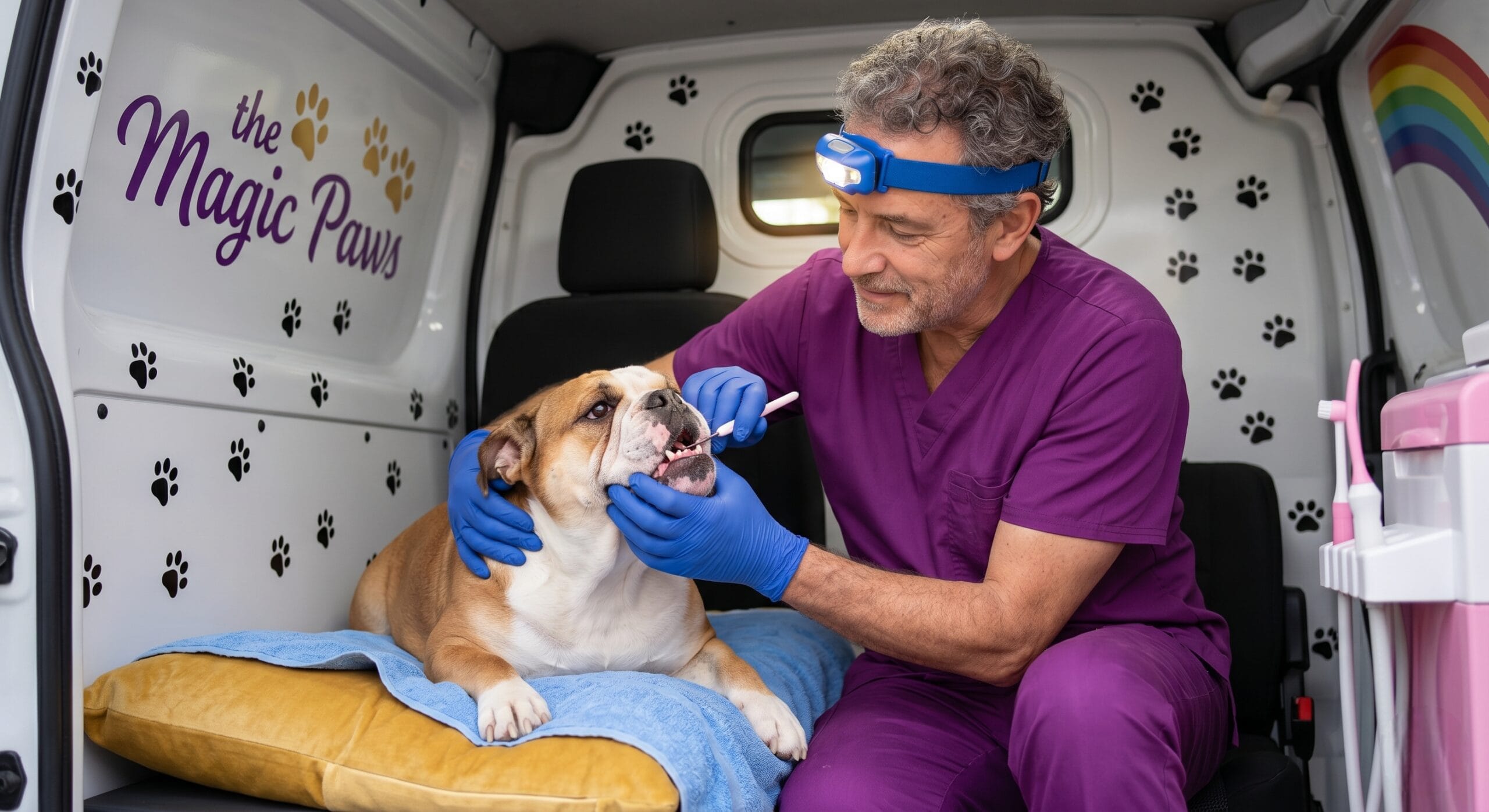
The Magic Paws provides anesthesia-free dental cleaning for dogs across Central Florida and Orlando, performed inside a dedicated mobile unit that comes to your home.
Every session includes Senses Therapy, a proprietary calming protocol that combines aromatherapy, music therapy, chromotherapy, and massage to keep dogs calm throughout the procedure. No sedation. No clinic visit. No stress for the dog.
If your dog has not had a professional cleaning in the past year, or if you are seeing signs like persistent bad breath, reddened gums, or visible tartar on the back teeth, that is a clear signal. Brushing at home is the right habit to maintain. Professional cleaning is what handles what the brush cannot reach.
Brushing gets you far. But it does not reach below the gumline, where most dental disease starts. The Magic Paws brings professional, anesthesia-free cleaning to your home across South Florida and Orlando. Book your dog’s cleaning today.
FAQ
Can I use human toothpaste to brush my dog’s teeth?
Never. Human toothpaste contains fluoride and xylitol, both toxic to dogs even in small amounts. Use only enzymatic toothpaste formulated for dogs. These products are designed to be swallowed without risk and come in flavors dogs actually accept.
What toothpaste is safe for dogs?
Enzymatic toothpaste accepted by the Veterinary Oral Health Council (VOHC) is the standard recommendation. The enzymatic formula does more than add flavor: it chemically reduces plaque through a biological reaction that continues even after brushing. Because the formula is designed for dogs, it is completely safe to swallow.
At what age should I start brushing my dog’s teeth?
As early as 8 to 12 weeks. Baby teeth still benefit from the habit because the goal at this stage is not cleaning permanent teeth: it is building tolerance for the routine before adult teeth arrive around six months. Dogs that learn to accept brushing as puppies rarely resist it as adults.
How long should each brushing session take?
One to two minutes total. Approximately 30 seconds per side. Short, consistent sessions are more effective than longer sporadic ones because plaque management depends on frequency, not duration.
What if my dog swallows the toothpaste?
With dog-formulated toothpaste, there is no risk. The formula is specifically designed to be swallowed. This is one of the main differences from human toothpaste, which should never be used for this reason.
Do dental chews replace brushing?
No. Dental chews reduce surface plaque through mechanical abrasion but do not eliminate it and cannot reach below the gumline. They are a useful complement to brushing, not a substitute for it.
How do I know if my dog has gum disease?
The most common signs are persistent bad breath, red or swollen gums, bleeding when the gums are touched, difficulty eating, and pawing at the mouth. If you notice any of these signs, consult a veterinarian before continuing your brushing routine.
Is anesthesia-free dental cleaning a good complement to home brushing?
Yes. Brushing removes surface plaque before it hardens. Professional anesthesia-free cleaning removes tartar that has already formed and reaches below the gumline, where the brush cannot go. The Magic Paws offers this service across South Florida and Orlando, bringing the cleaning to your home.
How much does professional dog teeth cleaning cost?
The Magic Paws pricing is structured by dog size: small dogs up to 29 lbs, medium dogs from 30 to 89 lbs, and large dogs at 90 lbs and up. All sessions include Senses Therapy, a proprietary calming protocol combining aromatherapy, music therapy, chromotherapy, and massage. The price is all-inclusive with no hidden fees.
How often does my dog need a professional dental cleaning?
The AVMA recommends at least once a year for most dogs. Small breeds may benefit from every six months due to faster tartar accumulation. Consistent home brushing can reduce how often professional cleaning is required, but it does not eliminate the need for it entirely.