Dog dental health by breed is one of the most overlooked dimensions of preventive care. Most owners think about brushing, treats, or the occasional vet visit. Few consider that their dog’s skull shape, muzzle length, and jaw structure already determine how much dental risk they carry before a single symptom ever appears.
A Chihuahua and a Labrador may both eat the same food, live in the same home, and receive the same level of daily attention. But their oral health trajectories are not the same. The Chihuahua is carrying 42 adult teeth in a jaw built for far fewer. The Labrador has proportionate space but risks slab fractures from hard chewing. Same species, fundamentally different dental realities.
This distinction matters because prevention without context is guesswork. Cleaning frequency, home care habits, and the point at which professional evaluation becomes necessary all depend on understanding what a dog’s breed is already predisposed to. Generic advice doesn’t account for that.
The sections below map the four main risk groups by anatomy, explain the mechanism behind each group’s vulnerability, and lay out what responsible preventive frequency actually looks like for each one.
Does your dog’s breed affect their dental health?
Yes, and the mechanism is structural. Dog dental health by breed is shaped by three factors inherited through genetics: jaw size relative to tooth count, skull compression, and muzzle width. These determine how teeth fit together, where plaque accumulates without natural removal, and how early periodontal disease can begin.
A dog doesn’t develop dental disease because of what it ate last week. The predisposition is built into bone structure. Breeds with compact jaws, flat skulls, or narrow muzzles carry a higher baseline risk regardless of how consistent home care is. That’s why understanding which group a dog belongs to is the starting point for a prevention plan that actually fits.
The four risk groups are: small and toy breeds (tooth crowding, retained deciduous teeth), brachycephalic breeds (malocclusion, compressed dental arches), narrow-muzzle breeds (deep periodontal pockets, overbite), and large breeds (tooth fracture, gingival hyperplasia).
Each group has a distinct mechanism, a distinct set of commonly affected breeds, and a distinct recommended cleaning frequency.
The table below summarizes the core data for each group.
| Breed group | Main dental risk | Most affected breeds | Recommended cleaning frequency |
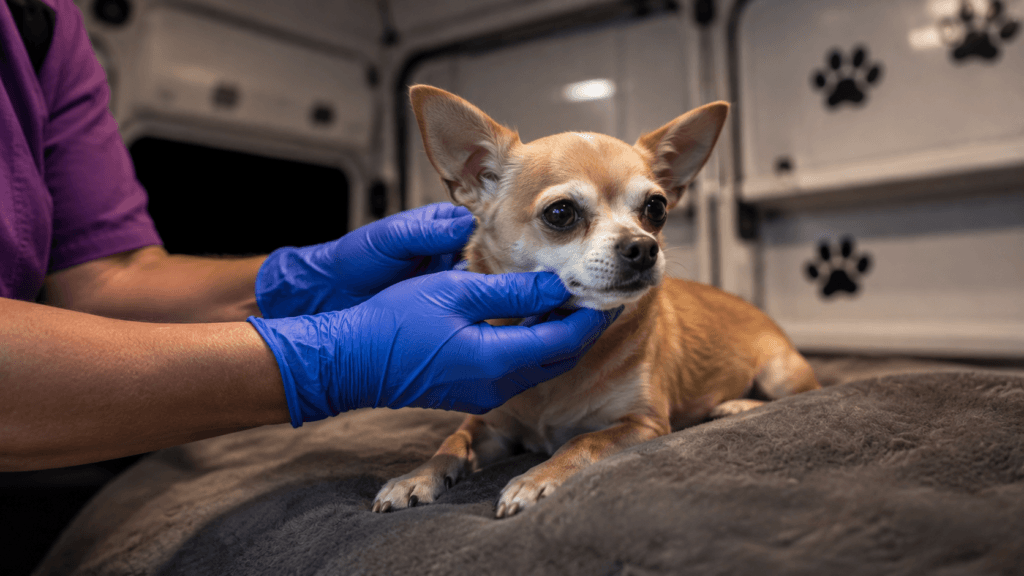
| Small / Toy | Tooth crowding, retained baby teeth, tartar buildup | Chihuahua, Yorkshire Terrier, Toy Poodle, Maltese, Pomeranian, Cavalier King Charles Spaniel | Every 6 months |
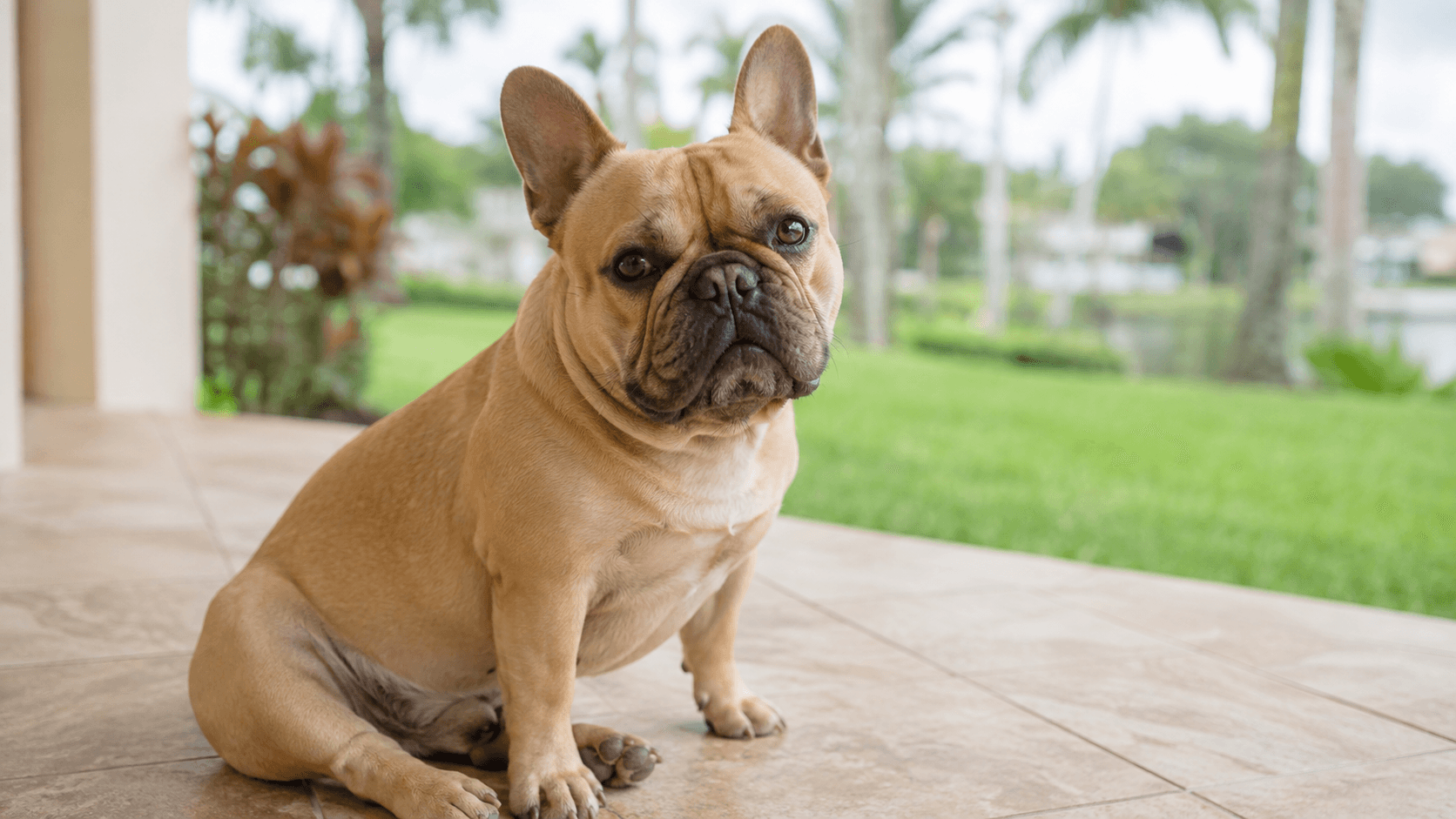
| Brachycephalic | Malocclusion, misaligned teeth, periodontal pockets | French Bulldog, Bulldog, Pug, Shih Tzu, Boston Terrier | Every 6 months |
| Narrow-muzzle | Periodontal pockets, overbite, exposed roots | Dachshund, Collie, Shetland Sheepdog, Greyhound | Annually with monitoring |
| Large breeds | Tooth fracture, gingival hyperplasia | Boxer, Great Dane, Mastiff, Labrador | Annually or as assessed |
For a deeper look at how dental disease progresses in dogs across all groups, the article on understanding dog dental disease covers the full mechanism from plaque to systemic risk.
Why do small and toy breeds have more dental problems?
Small dog dental issues stem from a single anatomical mismatch: toy and miniature breeds carry the same 42 adult teeth as a much larger dog, packed into a jaw that simply doesn’t have the space for them. The result is tooth crowding, retained baby teeth that never fall out on their own, and plaque accumulation in spaces too tight for natural cleaning.
When teeth press against each other or erupt at incorrect angles, the gum line can’t maintain normal contact with the tooth surface. That gap is where bacteria establish themselves and where dental plaque hardens into tartar without interference. In a small jaw, this process happens faster and in more places simultaneously.
Routine professional dog teeth cleaning is especially important for this group precisely because home brushing alone can’t reach the most vulnerable sites.
The breeds most consistently affected by these structural limitations include:
- Chihuahua
- Yorkshire Terrier
- Toy Poodle
- Maltese
- Pomeranian
- Cavalier King Charles Spaniel.
Research published by the American Veterinary Medical Association indicates that periodontal disease affects the majority of dogs by age three, with small breeds showing signs significantly earlier than the average.
Early diagnosis changes the outcome for this group. A proper dental exam for pets before visible symptoms appear is often where high-risk owners catch retained deciduous teeth or early gum recession before they require more complex intervention.

What makes brachycephalic breeds more vulnerable to dental disease?
Brachycephalic dog dental care presents a distinct challenge: the compressed skull compresses the dental arch too, forcing teeth into positions they weren’t designed to occupy. Malocclusion (the misalignment of upper and lower teeth) is the direct consequence. Misaligned teeth create irregular contact points where plaque collects without the natural scraping action that normal occlusion provides.
The breeds most associated with this pattern include French Bulldogs, Bulldogs, Pugs, Shih Tzus, and Boston Terriers. In these dogs, the upper jaw is often wider than the lower jaw, or the lower jaw protrudes forward, creating contact patterns that concentrate bacterial accumulation in predictable zones. Home brushing addresses surface plaque but rarely reaches the pockets that form at irregular contact points.
Because these breeds already carry elevated anesthetic risk due to their airway anatomy, no-anesthesia dog teeth cleaning is a particularly relevant option for routine preventive maintenance. Owners typically want to know how long a dog dental cleaning takes before scheduling, and for brachycephalic breeds, understanding the process helps remove the hesitation that delays care.
For those concerned about procedure safety across any method, the data on how many dogs die from teeth cleaning puts the risk in factual context.
Brachycephalic dogs and malocclusion: what owners need to know
Malocclusion in brachycephalic dogs doesn’t just cause cosmetic misalignment. When teeth meet at incorrect angles, the pressure on gum tissue creates micro-gaps between the tooth root and the surrounding gum. These gaps, called periodontal pockets, trap food debris and bacteria in an environment that resists cleaning.
Over time, the bacterial load in those pockets triggers an inflammatory response. The gum begins to recede, exposing more of the root and deepening the pocket further. That progressive recession is the mechanism behind periodontal disease in this group, and it typically advances faster than in breeds with normal occlusion because the structural cause remains constant. Preventing the buildup in those pockets, through consistent professional maintenance, is the only way to interrupt that cycle before it reaches irreversible tissue loss.
Are narrow-muzzle breeds at risk for periodontal pockets?
Yes. In narrow-muzzle breeds, the elongated jaw concentrates the space between the gum margin and the tooth root in a way that creates deep periodontal pockets without the crowding seen in small breeds. The mechanism is different, but the bacterial outcome is the same: accumulated plaque in areas that home brushing doesn’t reach.
Breeds such as the Dachshund, Collie, Shetland Sheepdog, and Greyhound carry a structural predisposition to this pattern. Overbite is also common in this group, where the upper jaw extends beyond the lower one, creating irregular contact along the front teeth. That misalignment generates the same pocket-forming effect as malocclusion, though through a different skeletal path.
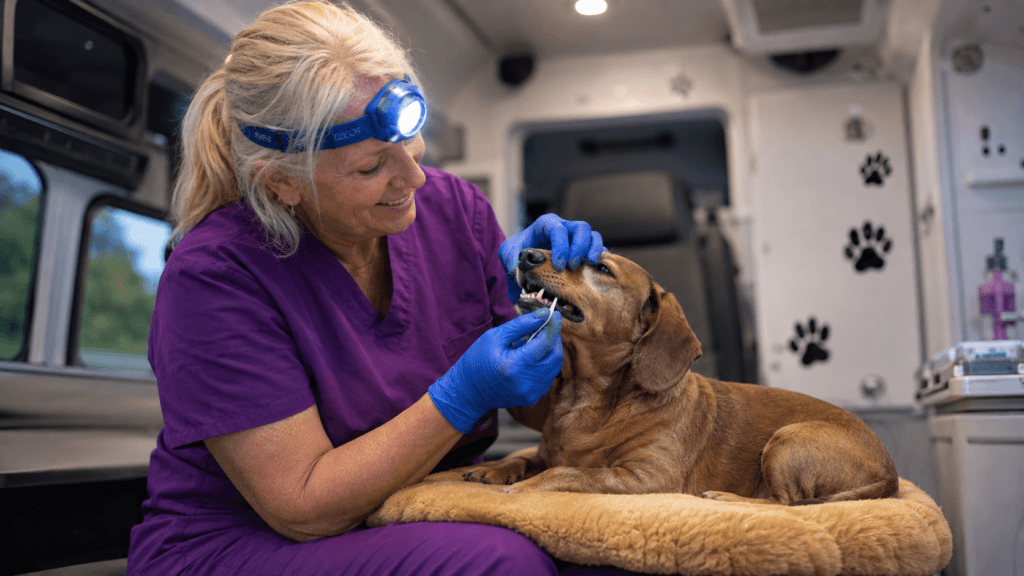
Because the risk in narrow-muzzle dogs is less visible than the obvious crowding of a Chihuahua’s mouth, it often goes unaddressed longer. Regular visits to a mobile dog dentist eliminate the logistical barrier that leads owners to delay professional evaluations for this group.
Do large breeds have fewer dental health risks by breed?
Not exactly. Large dog dental health looks different from small and brachycephalic groups, but it carries its set of structural risks. Dogs like Boxers, Great Danes, Mastiffs, and Labradors have proportionate jaw space, which means periodontal disease rates are genuinely lower in this group. The crowding and malocclusion issues that drive early disease in smaller animals are largely absent.
The risks that replace them are mechanical rather than inflammatory. Large breeds chew with significant force, and hard objects (bones, antlers, nylon toys) can cause slab fractures: the splitting of a major tooth, typically the upper fourth premolar. A fractured tooth exposes the pulp canal to bacteria, creating an infection pathway that requires veterinary treatment.
Gingival hyperplasia (excess gum tissue growth) is also more common in this group, particularly in Boxers and Mastiffs. The overgrown tissue creates pockets along the gum line that trap food and bacteria in a way that mimics, in a limited form, the pocket problem in narrow-muzzle breeds. Large-breed owners who assume size means safety miss this distinction.
How often should high-risk breeds get a professional dental cleaning?
The cleaning frequency depends directly on the anatomical risk group: small breeds and brachycephalics every 6 months, narrow-muzzle breeds annually with active monitoring between visits, and large breeds annually or as assessed by the clinician. These intervals aren’t cosmetic guidelines. They reflect the biological pace at which tartar accumulates and tissue damage progresses in each group.
For small and brachycephalic dogs, the 6-month schedule exists because their structural risk doesn’t reset between visits. Plaque builds on tooth surfaces continuously, and in a crowded or misaligned mouth, the speed of that accumulation outpaces what home care can manage.
Waiting 12 months in this group often means arriving at a visit with significantly more calculus and early gum recession than a 6-month schedule would allow.
For owners looking at options that fit an every-6-month routine, dog dental cleaning without general anesthesia reduces both the logistical and biological cost of frequent maintenance.
Finding dog teeth cleaning near me in Florida is the practical first step, and the availability of mobile teeth cleaning for dogs means the appointment comes to the owner’s home, eliminating the scheduling friction that causes high-risk owners to postpone.
What does your dog’s breed tell you about the care they actually need?
Breed is a risk map, not a verdict. Knowing that a dog belongs to a high-risk group tells you where the vulnerabilities are and at what pace they develop. It doesn’t tell you the outcome is fixed.
A Pomeranian whose owner understands the tooth crowding risk and schedules consistent professional cleanings has a fundamentally different oral health trajectory than one whose owner assumes small dogs are low-maintenance. The biology is the same. The timeline is not.
The gap between awareness and action is where most preventive care fails. Owners who know their breed’s risk profile act earlier, monitor more closely, and don’t wait for visible symptoms before seeking professional evaluation. Symptoms, in most cases, appear only after the disease has already progressed through its earliest and most reversible stages.
Prevention isn’t a luxury for dog breeds with structural dental risk. It’s the only strategy that works before the damage becomes permanent.
Your dog’s breed puts their teeth at higher risk. Book a dental cleaning before the first signs appear.
Frequently asked questions about dog dental health by breed
What is the most common dental disease in dogs by breed?
Periodontal disease is the most common dental condition across all dog breeds. Small breeds and brachycephalics are the groups most consistently and most severely affected, often developing clinical signs before age 3. In these dogs, the structural causes (crowding and malocclusion) make bacterial accumulation faster and harder to interrupt through home care alone.
Can a dog’s breed determine when dental problems start?
Yes. Small breeds and brachycephalic dogs can show early signs of periodontal disease as young as 2 years old. Large breeds typically develop difficulties later in life, and the nature of those problems differs: fractures and gingival changes rather than the progressive gum recession common in smaller animals.
What are the early signs of dental disease in dogs?
The earliest observable signs include persistent bad breath that doesn’t resolve with brushing, red or swollen gums along the tooth line, visible yellow or brown tartar on the back teeth, and reluctance to chew on one side. Any of these warrants a professional evaluation, because by the time they’re visible, the underlying disease has typically been progressing for months.
Is anesthesia-free dental cleaning safe for all dog breeds?
For most breeds, yes, when a prior eligibility assessment confirms the dog is a suitable candidate. Brachycephalic breeds in particular benefit from anesthesia-free maintenance because it avoids the additional anesthetic risk their airway anatomy creates. The key condition in any approach is that the professional performs an individual evaluation before proceeding.
Do mixed-breed dogs have fewer dental problems than purebreds?
Not necessarily. Mixed breeds that inherit high-risk anatomical traits (compact jaw, short muzzle, narrow skull) can carry the same structural vulnerabilities as purebred dogs in the corresponding risk group. The determining factor is anatomy, not pedigree or registration status.
How does tooth crowding cause gum disease in small dogs?
When 42 teeth occupy a jaw designed for fewer, individual teeth press against each other or erupt at unnatural angles. The gum can’t maintain normal contact with each tooth surface in those compressed zones. Plaque accumulates in the gaps without the natural cleaning action that normal tooth alignment allows. The gum becomes inflamed, begins to recede, and eventually forms periodontal pockets that deepen over time.
What dog breeds have the best dental health?
Medium to large breeds with proportionate muzzles and normal jaw alignment tend to have the lowest rates of periodontal disease. Labradors, Golden Retrievers, and German Shepherds are consistently among the lower-risk groups. That said, no breed is immune to dental disease without active preventive care, and even low-risk dogs require periodic professional attention.
How can I tell if my dog’s breed puts them at higher dental risk?
Check three things: body size (small or toy = higher risk), muzzle shape (flat or very short = brachycephalic risk, very narrow and elongated = narrow-muzzle risk), and whether the breed appears in the high-risk lists above. If any of those apply, scheduling a professional dental evaluation is the right starting point, regardless of whether symptoms are visible.
Does dog dental health by breed affect their overall lifespan?
Yes. Untreated periodontal disease allows bacteria to enter the bloodstream through compromised gum tissue, where they have been associated with cardiac and kidney complications. High-risk breeds that don’t receive preventive care have a longer cumulative exposure to that bacterial load over their lifetime.
How do I book a dental cleaning for my dog in Florida?
The Magic Paws offers mobile, anesthesia-free dental cleaning for dogs across Florida. Scheduling is available directly at themagicpaws.com/#pricing, where you can select your region and review the service options for your dog’s size.